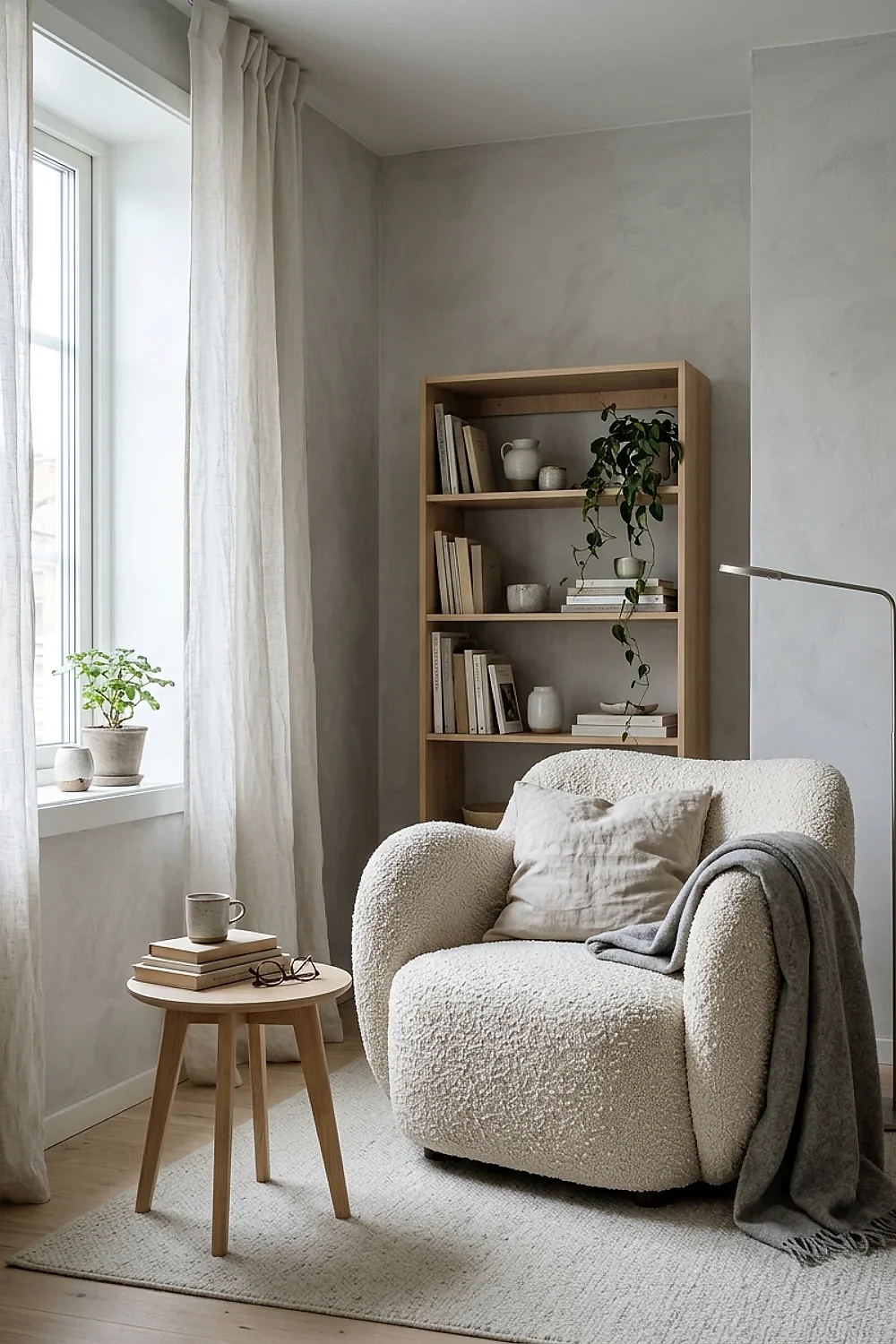
23 Boucle Reading Nook Chairs That Hold Up
You’ll finish this guide knowing which boucle reading nook chair shape fits your corner, which fabric survives daily life, and what to place around it so the nook still gets used after week two.
Twenty-three specific moves follow, from seat height down to bulb temperature. Skim the headings, pick the two or three that fit your room, and skip the rest.
What designers look for in a boucle reading nook chair
A good reading chair has to pass a plain test: can you sit in it for 90 minutes with a heavy hardcover and not shift once? Looks come second. Boucle’s nubby, looped surface only earns its place if the frame underneath is built for lingering.
Here’s the short checklist professionals run before anything else:
- Seat depth of 20-22 inches, so you can curl a leg up without the front edge cutting into your calves.
- A back that reaches at least the base of your skull.
- Foam density around 1.8 pounds per cubic foot or higher.
- Enough floor clearance to vacuum under the frame.
1. A barrel-back swivel chair about 30 inches wide
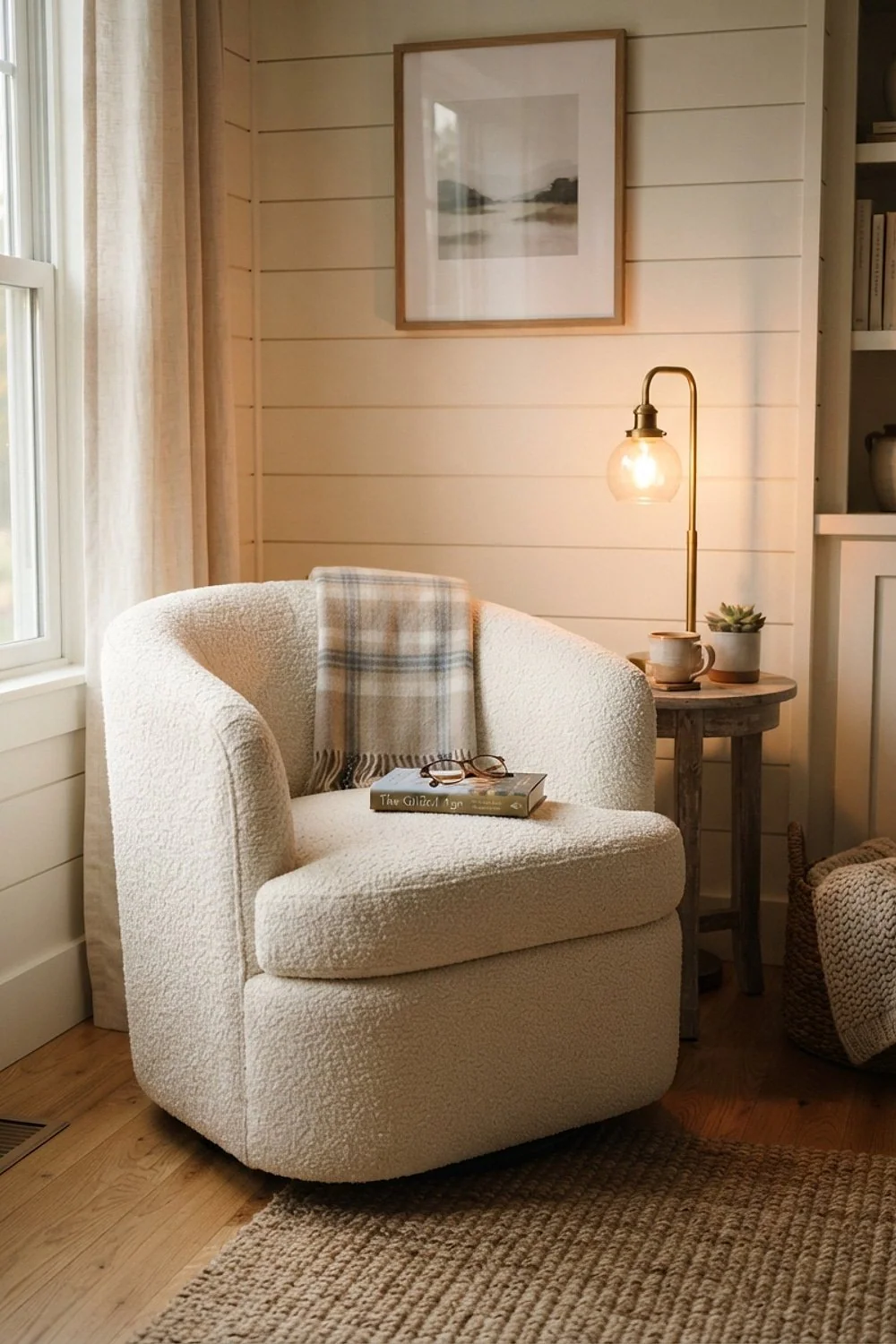
A barrel back is the shape that disappears into a nook best. The rounded shell wraps your shoulders, so the chair feels held rather than perched, and the curve softens a room full of right angles.
It suits studio apartments and bedroom corners where a boxy armchair would eat 36 inches or more. Check the swivel plate before buying: one that wobbles under load will creak within a season, and decent versions from West Elm or Article run roughly $600-$1,200.
2. Ivory with a warm undertone, not stark white
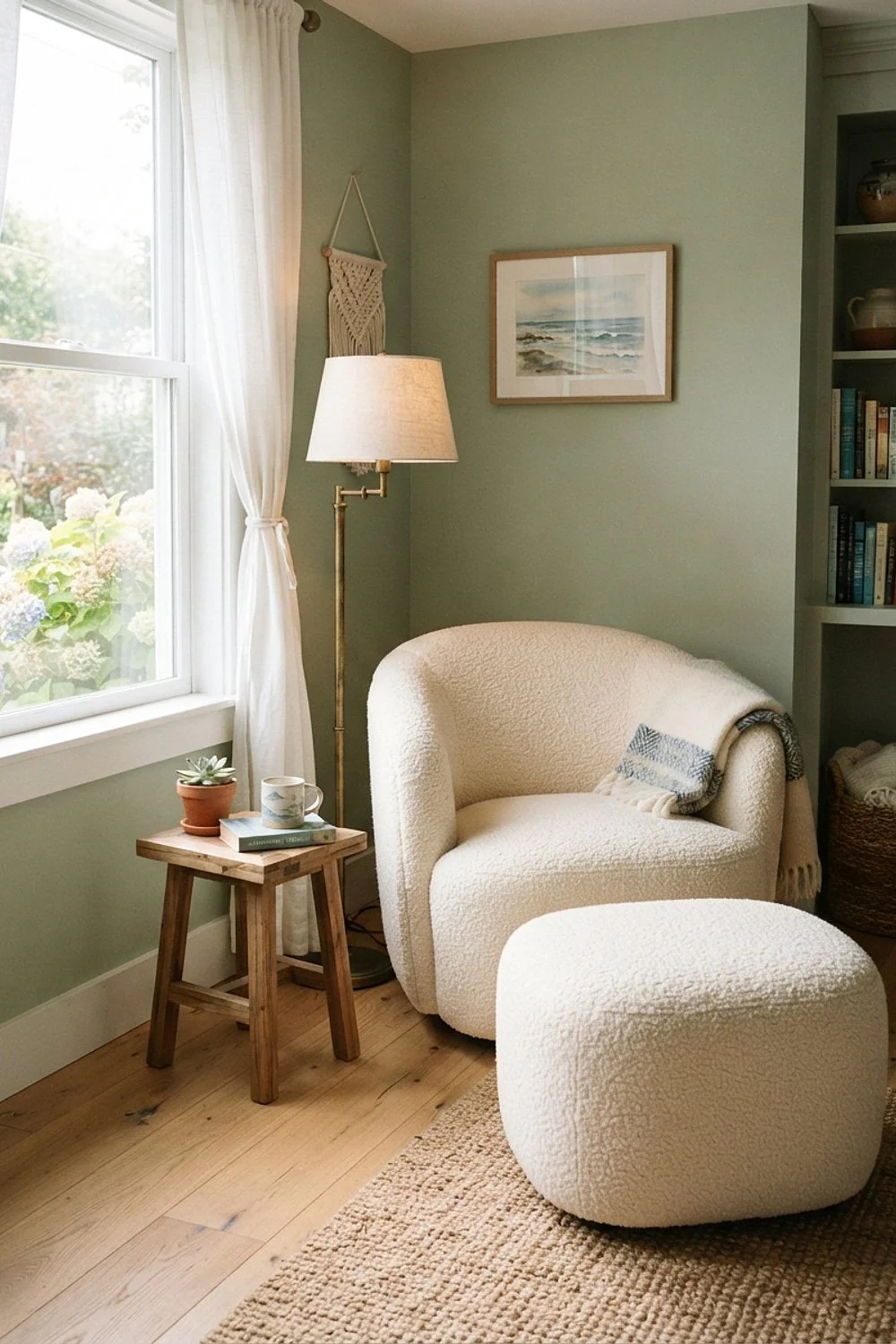
Boucle in a creamy ivory, close to Benjamin Moore Pale Oak in mood, holds light the way linen does. Bright optical white turns chalky under cool LED bulbs and shows every shadow in the loops.
This is the right call for north-facing rooms, where daylight already leans blue. Hold a fabric swatch against your wall at 4pm before ordering, because yellow-leaning cream can look custard next to a gray paint.
3. A seat height of 17 to 18 inches
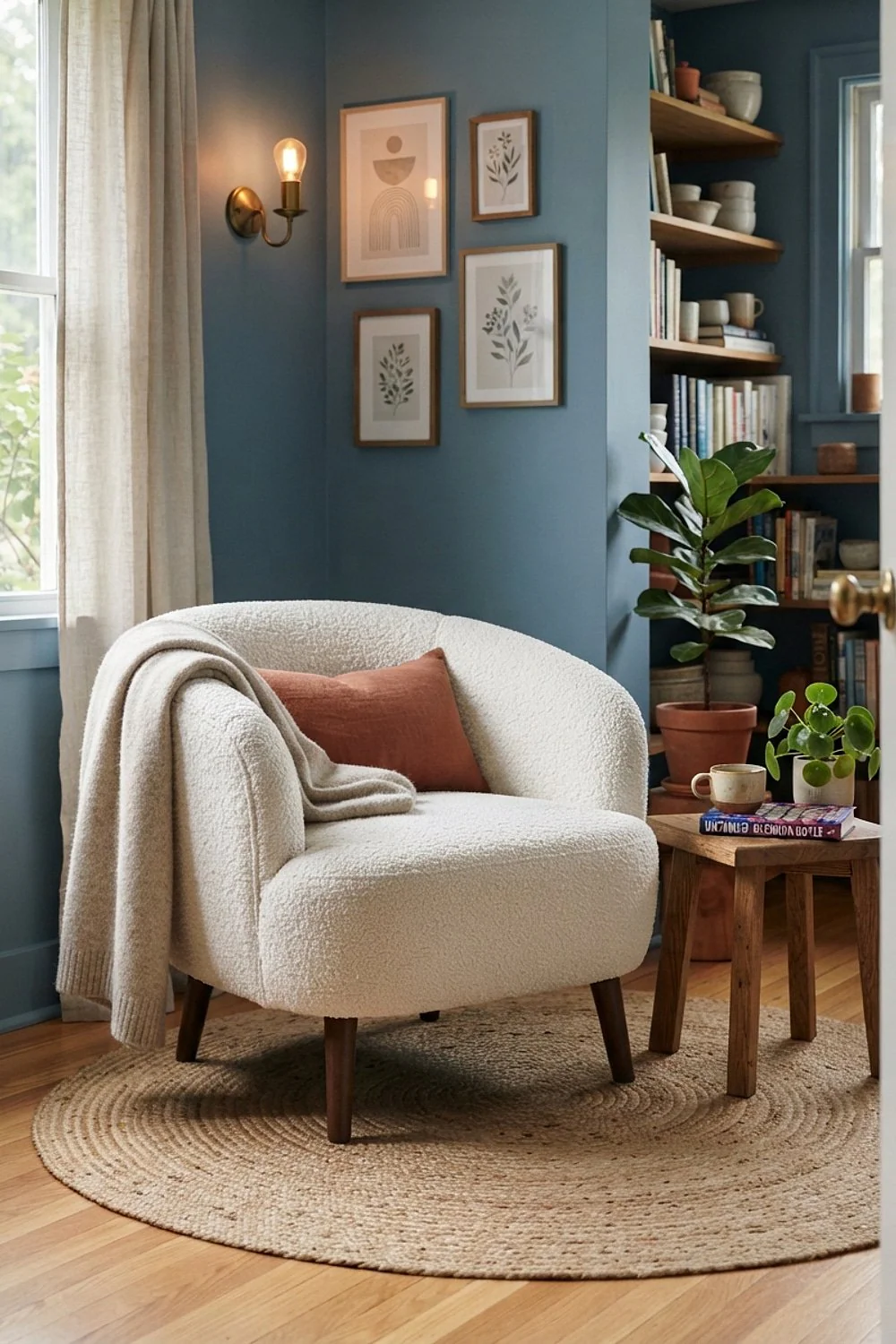
Feet should land flat on the floor with your knees at roughly a right angle. Anything lower than 16 inches turns standing up into a small workout, and anything over 19 leaves shorter readers dangling.
Firm foam matters more than the height number alone. A soft seat compresses 2-3 inches in the first year, so buy it taller than you think you need.
4. A low shelf within arm’s reach
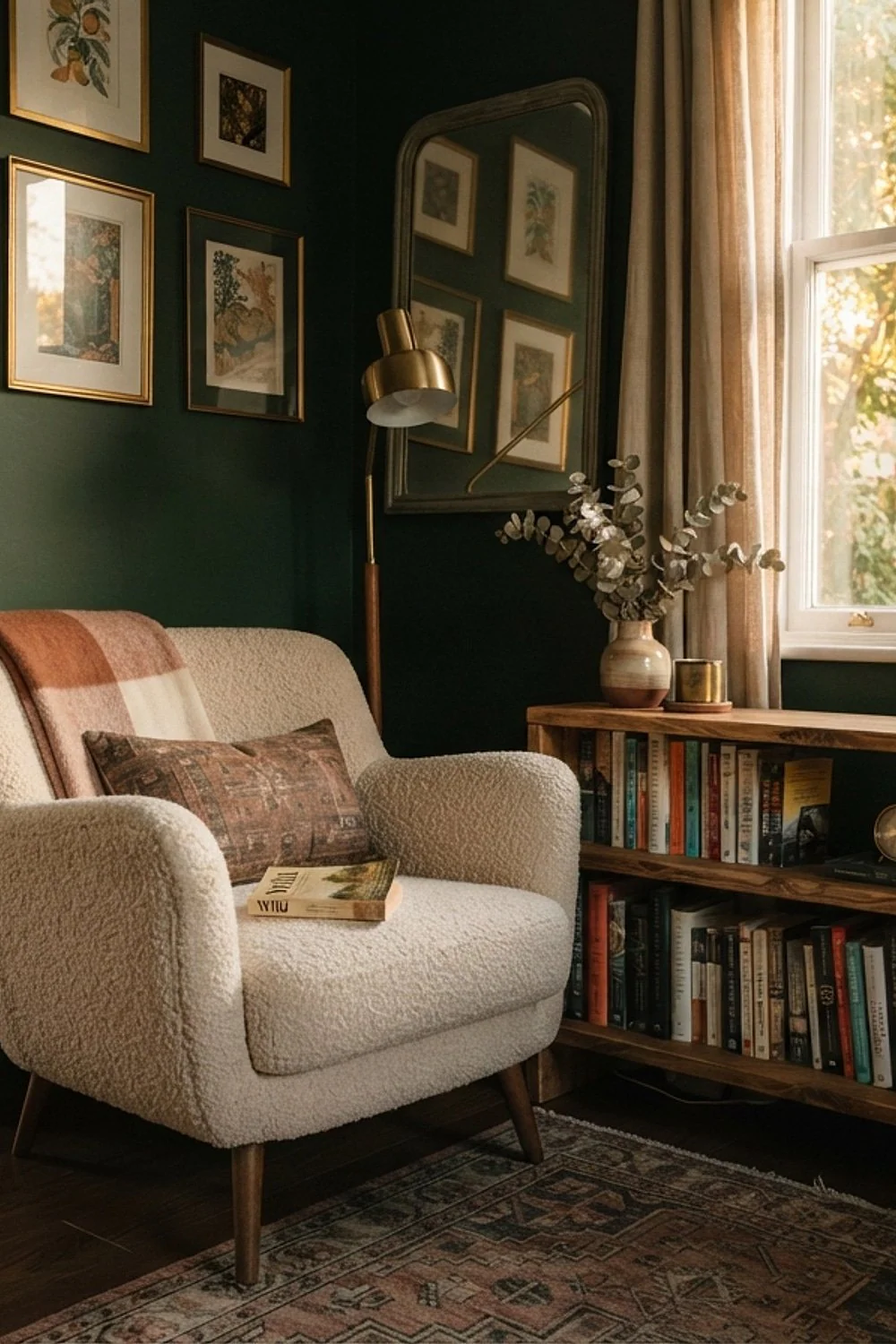
A shelf at 24-30 inches high, right beside the arm, keeps the current book, the glasses case and the second book in one place. Otherwise they migrate across the house and the nook stops feeling like a destination.
A narrow bookcase 10-12 inches deep works in tight alcoves. Skip anything deeper, because it eats the elbow room that makes the nook comfortable.
5. A swing-arm sconce on the wall behind the chair

A plug-in swing-arm sconce frees up floor and puts light exactly over the shoulder, which is where a page needs it. An Anglepoise-style wall lamp or an IKEA plug-in model costs about $40-$150 and needs no electrician.
On a gray November afternoon at 4pm, the window gives out first. The sconce is what keeps the nook usable through the long evening.
Fabric, scale and layout choices for a boucle reading nook chair
6. Wool boucle in a home with a dog or cat

Natural wool loops are the first to snag on claws, rings and the zipper of a hoodie. In a household with two kids and a retriever, one pulled loop becomes a runner within weeks.
If pets are in the picture, choose a tight, small-loop weave and trim any snag flush instead of pulling it. And keep the chair out of the dog’s favorite window spot.
7. A 16-inch-high ottoman for the long sessions
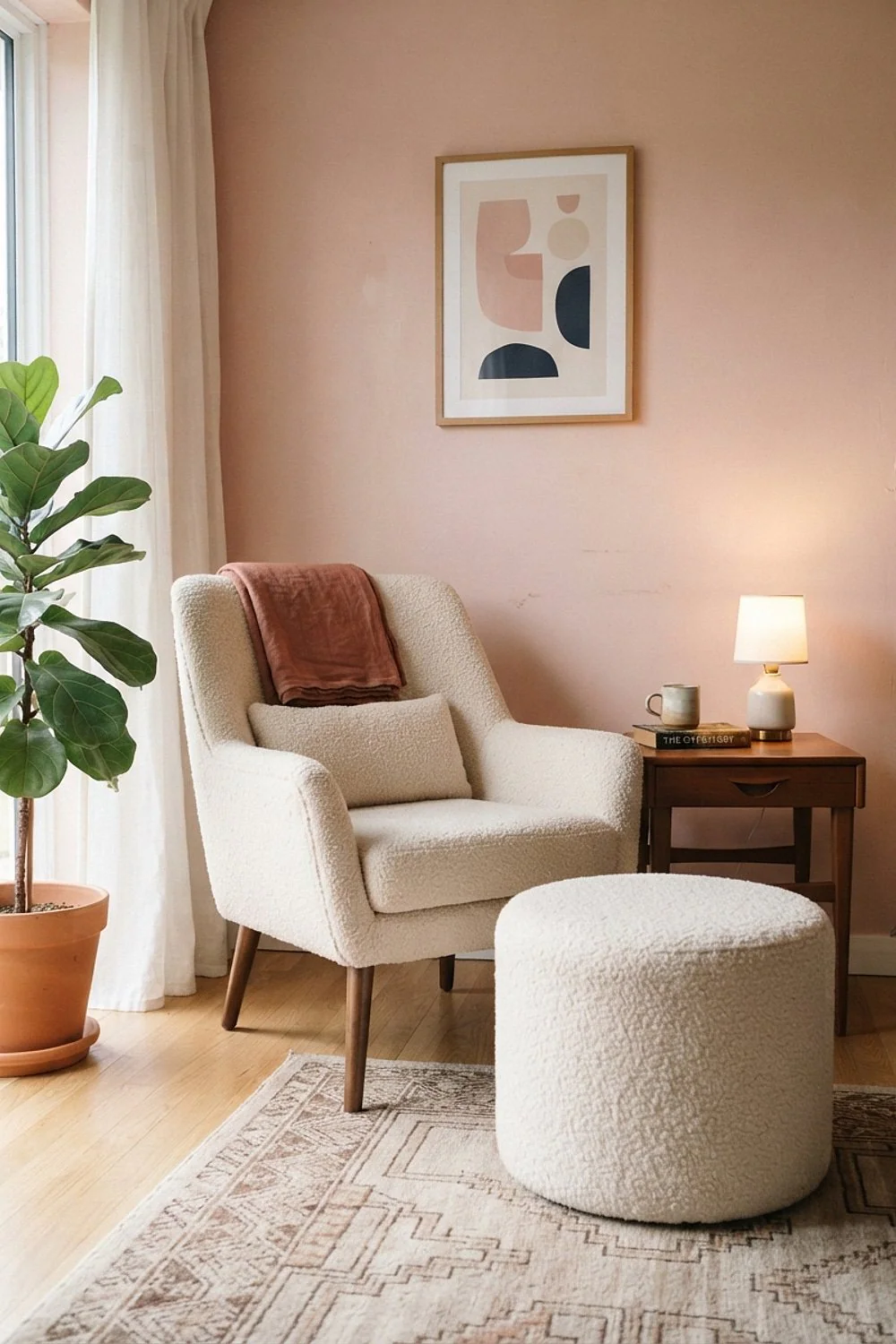
An ottoman at 16-17 inches, just under seat height, lets your legs stretch without tilting your hips. Round ones in matching boucle read as one piece with the chair, while a leather pouf adds a useful contrast.
It earns its keep for readers who sit longer than an hour. If the nook is under 4 feet deep, a footstool that tucks away beats a full ottoman that blocks the walkway.
8. A 28-inch-wide chair in a 4-by-5-foot alcove
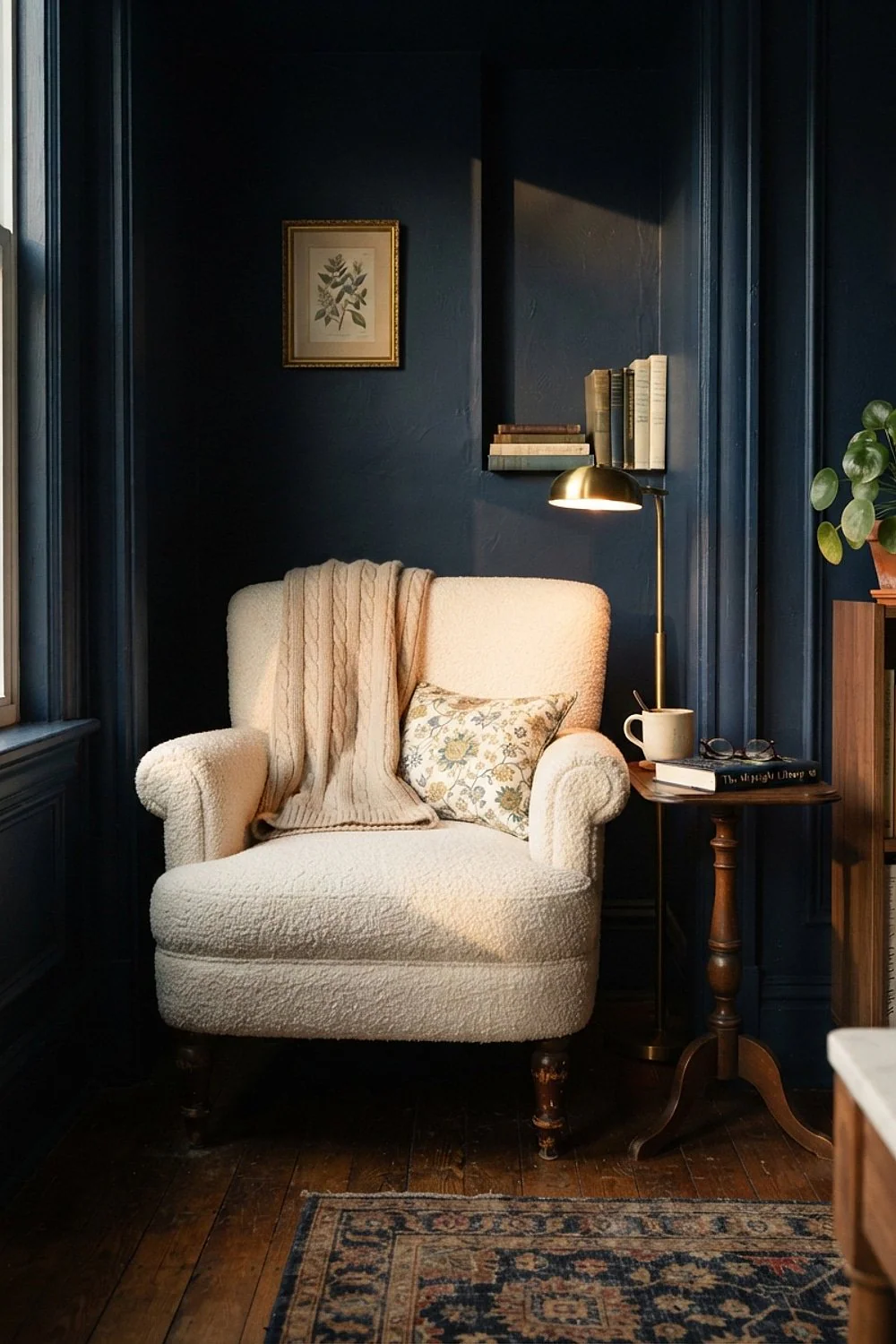
A chair this size leaves about 10 inches on each side in a 4-foot niche, enough to get in and out without scraping the wall. Oversized lounge chairs look generous in a showroom and then wedge into small corners.
Measure the diagonal of the doorway too. Plenty of 34-inch-wide chairs have been returned because they wouldn’t clear a 30-inch bedroom door.
9. Angling the chair 30 degrees off the wall
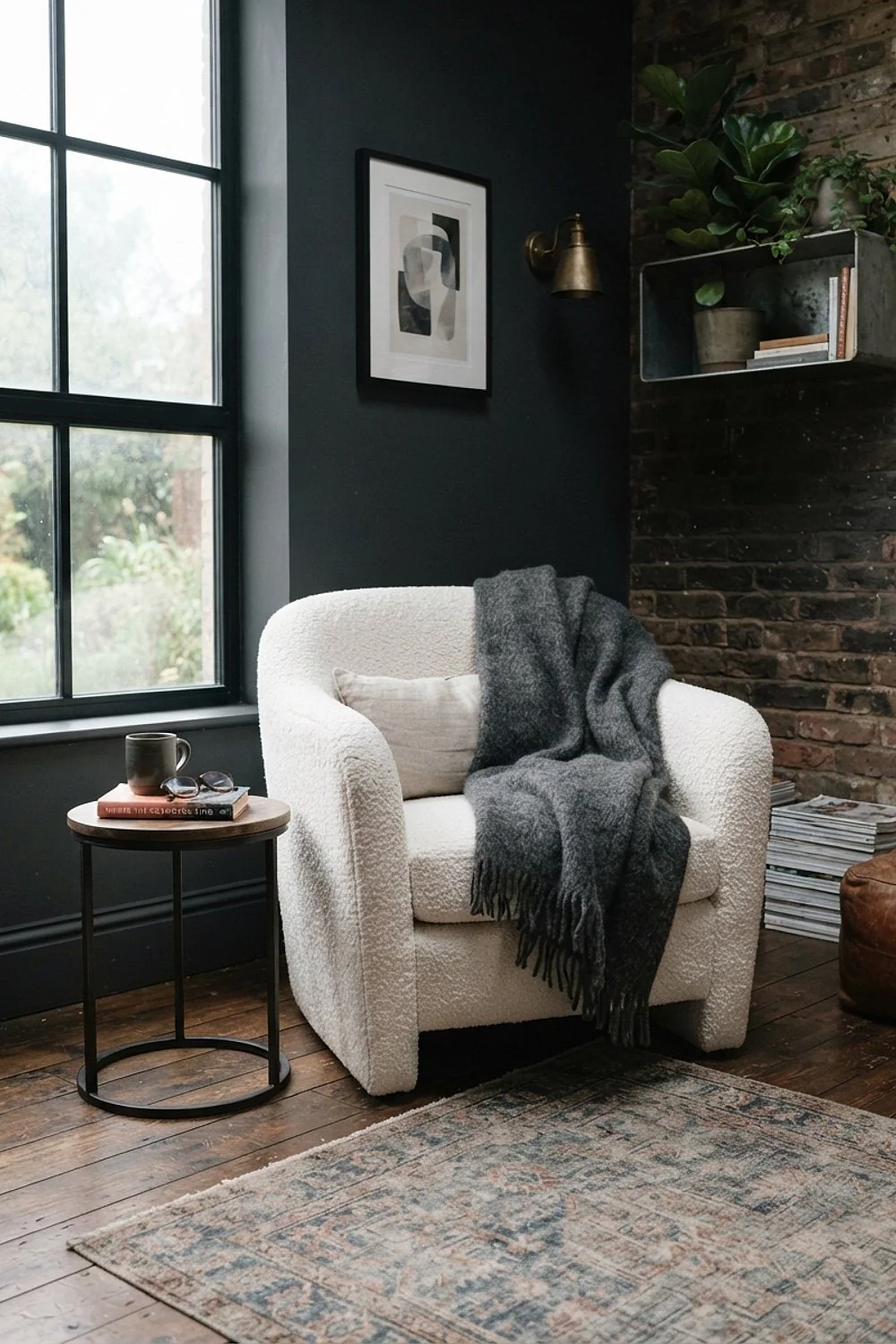
Conventional advice says to push every chair snug into its corner. Skip that. A chair turned about 30 degrees toward the window catches daylight over the shoulder, and the gap behind it hides cords and makes the whole corner feel deeper.
The trade-off is losing roughly 8 inches of floor. In a room smaller than 10 by 10 feet, keep the chair flush and angle only the lamp.
10. Performance polyester boucle for daily use
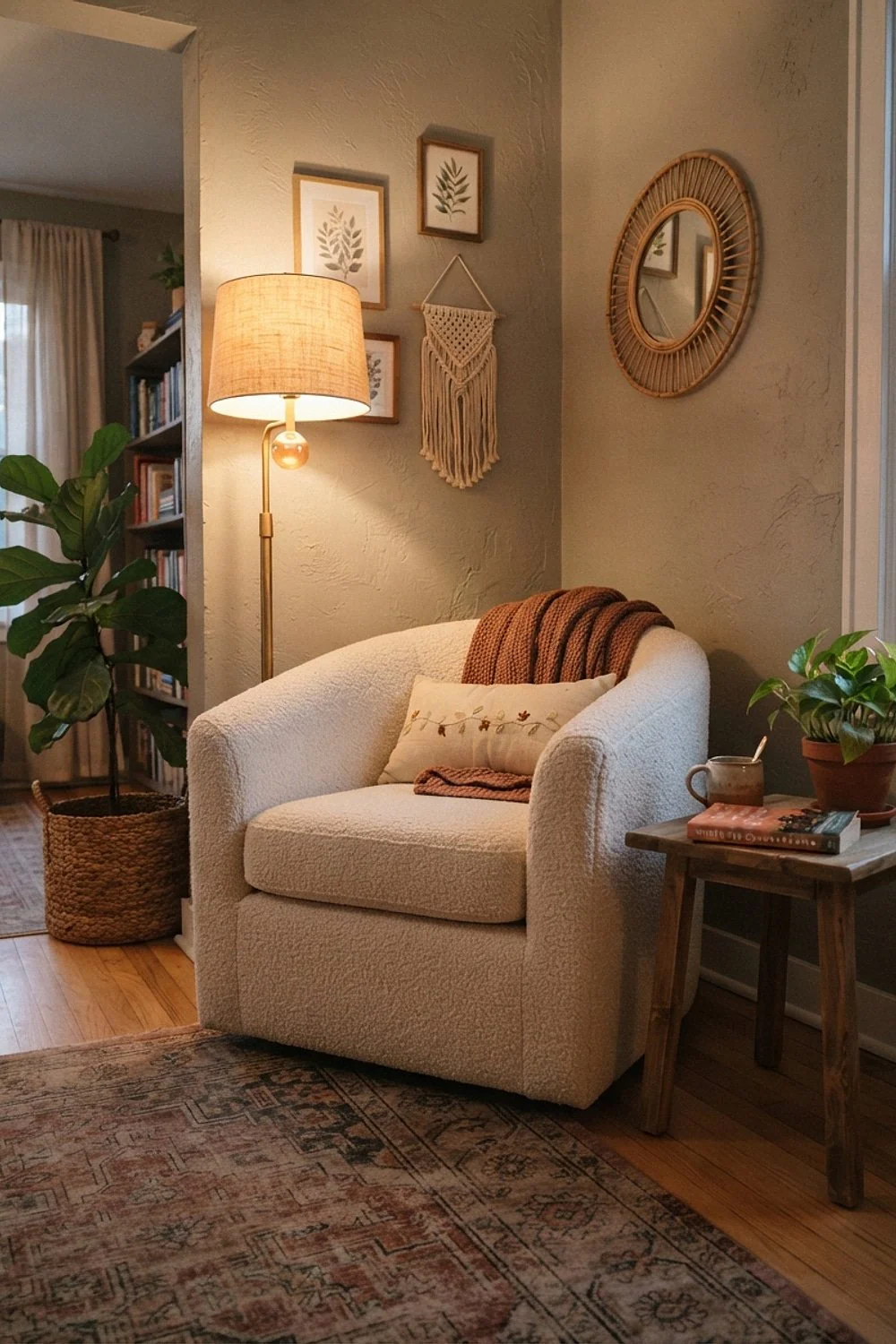
Here’s a counterintuitive fact: the looped surface hides crumbs, lint and light dust better than a flat weave does. What it doesn’t hide is snags, which is why a polyester blend rated for 30,000 double rubs beats pure wool for heavy use.
Expect to pay $200-$400 more than a basic upholstery grade. Spot-clean with a dry sponge and a drop of mild soap, and never scrub, because rubbing flattens the loops.
11. Dark walnut or black metal legs against the pale fabric
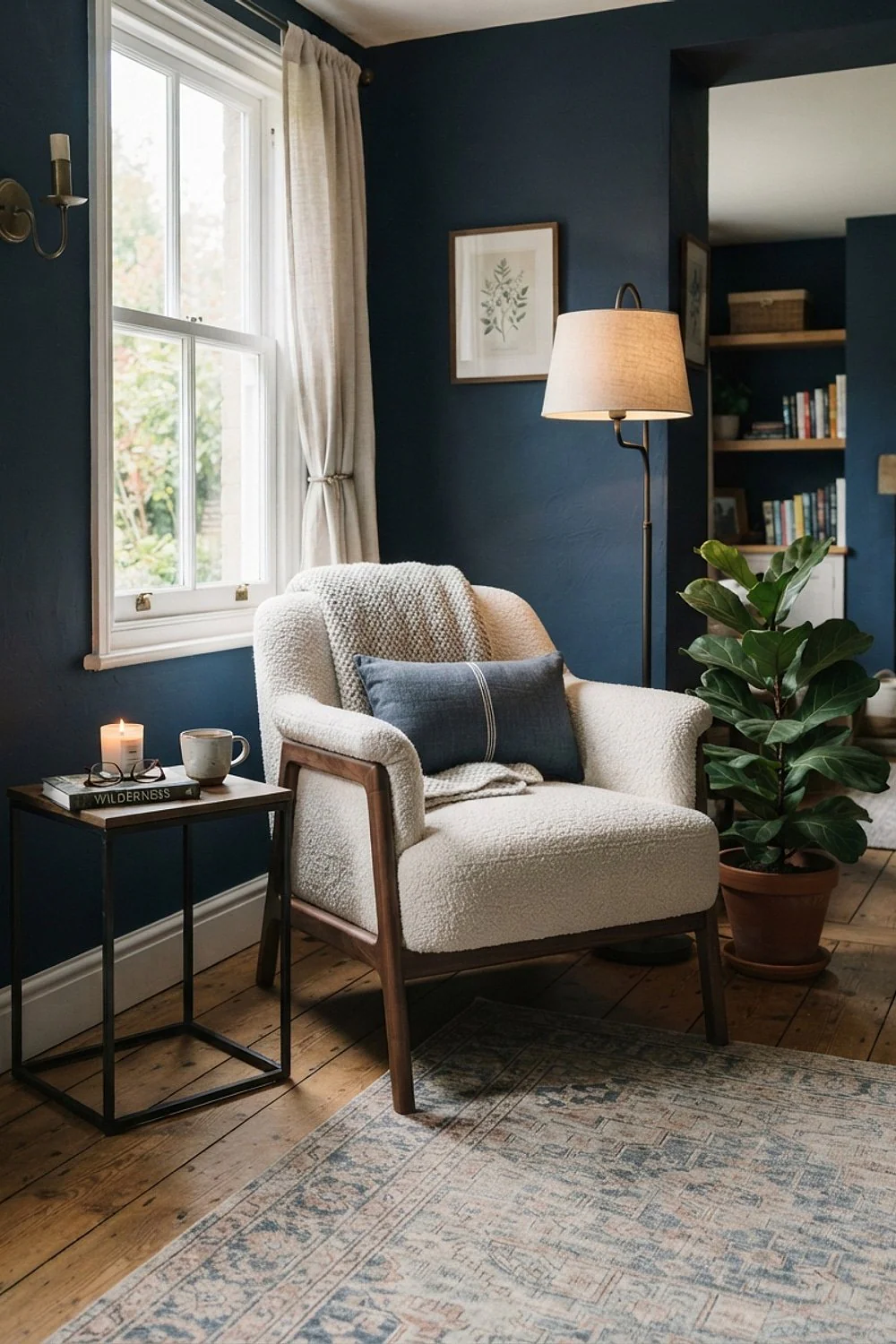
Matte black legs or a dark walnut plinth under the chair give the soft fabric a hard edge to push against. Without it, an all-cream chair on a pale rug can look like a cloud with no outline.
This works best when the same dark tone repeats once nearby, such as a picture frame or a lamp base. Two or three repeats start to look matched, which is the opposite of the goal.
Companion pieces that make the nook work
12. A deep olive or forest wall behind the chair
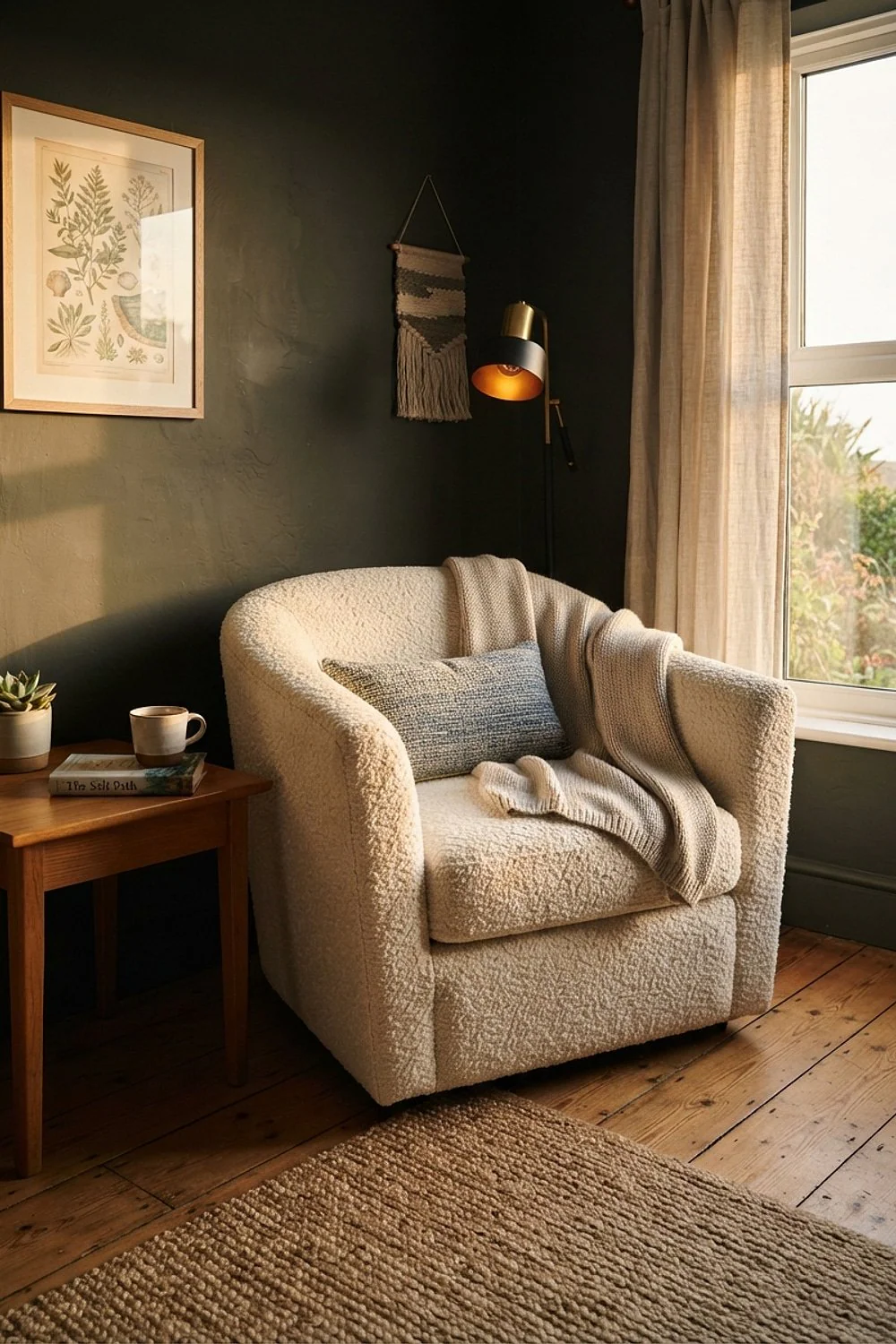
A saturated green such as Farrow & Ball Studio Green makes ivory boucle glow, because the fabric reads brighter against a dark backdrop. Pale gray walls flatten it.
Paint only the nook wall, or the alcove itself, in a matte or eggshell finish, which keeps reflections soft and hides roller marks. That makes it a good fit for a small budget, since one wall takes little paint. A full room in dark green asks a lot of a space with one window.
13. A lidded basket for the throw blanket

A lidded rattan basket, 16-18 inches across, keeps a wool throw within reach and out of sight, and the woven sides let the wool breathe so it stays fresh. A blanket draped over the chair arm looks tidy for about one day, then slides to the floor.
That size tucks beside the chair in a small corner and suits anyone in a flat with little storage. Choose a lid that lifts with one hand. If the basket takes two hands to open, the throw ends up on the sofa instead.
14. A wall-mounted picture ledge instead of a bookcase
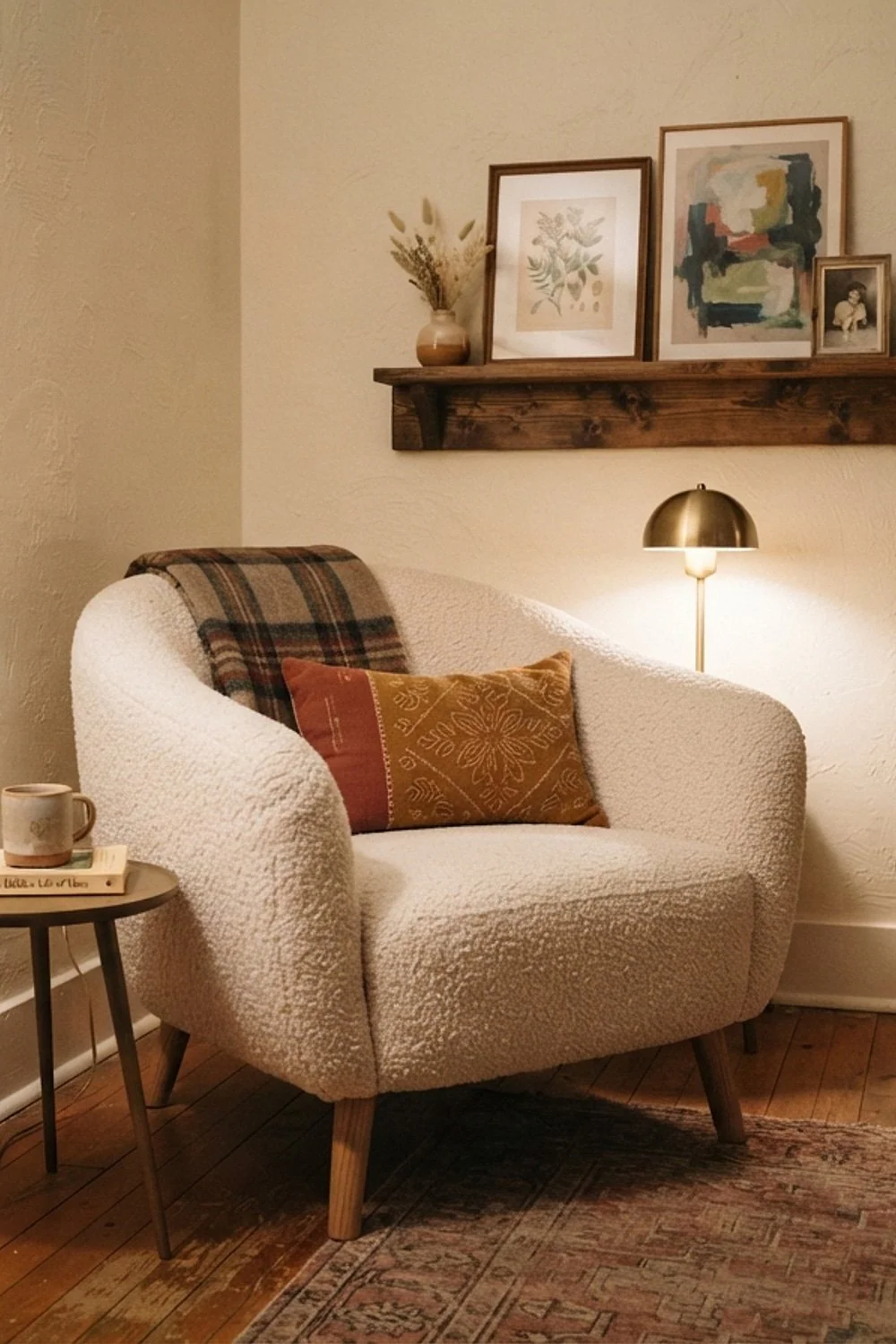
A 5-inch-deep ledge, about 48 inches wide, holds a stack of current reads and a small lamp for around $30 at IKEA. It frees the floor, which matters when the chair’s rounded base already takes up space.
Mount it 12 inches above the chair arm so you can reach without twisting. Anchor into studs if the stack will include hardcovers.
15. A 2700K bulb in a paper lantern
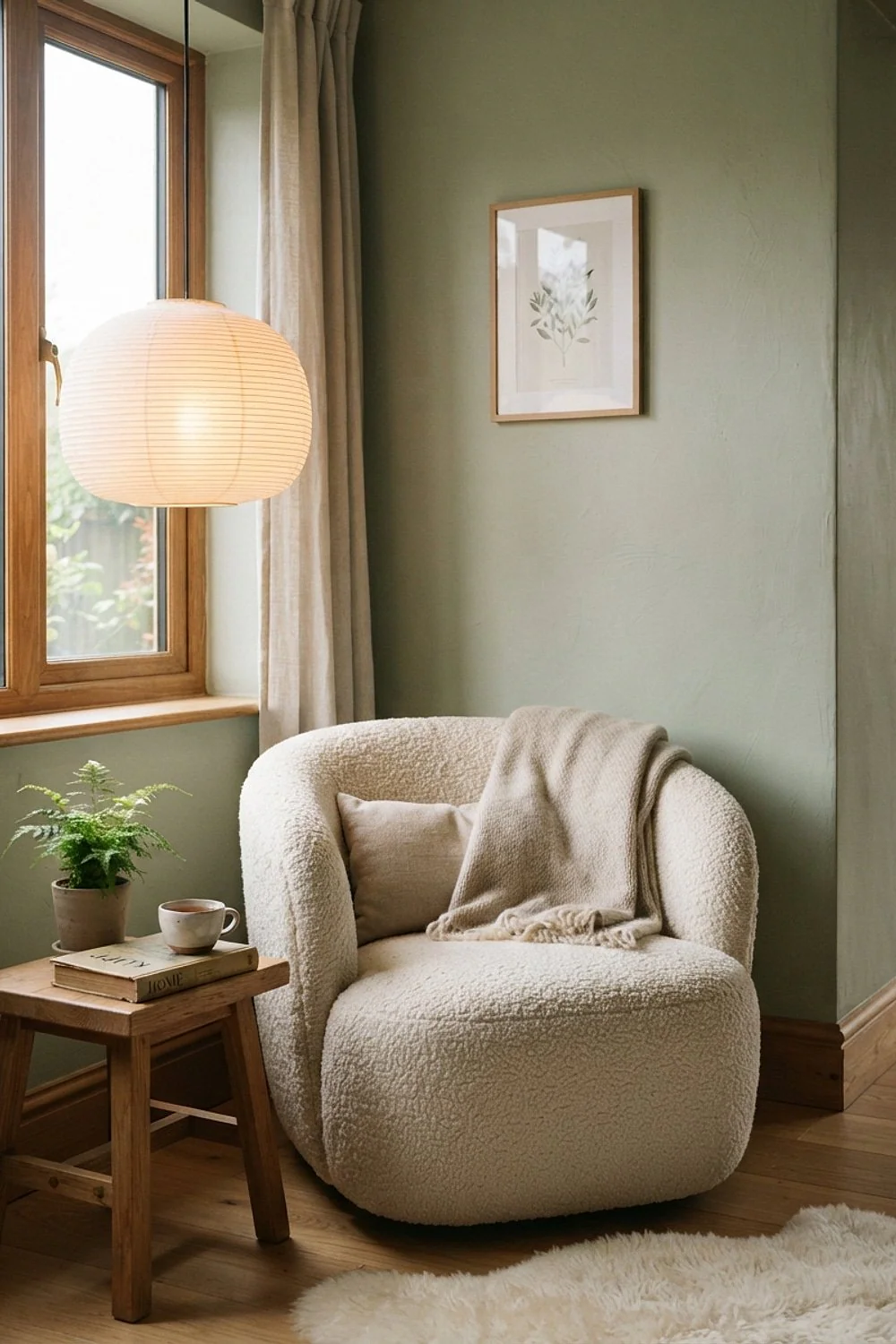
A Noguchi-style paper lantern or an IKEA Hektar-style floor lamp with a 2700K bulb gives the amber light that flatters cream loops. Cooler bulbs at 4000K turn boucle gray and make the book glare.
Choose a bulb of at least 800 lumens for reading, with a dimmer if possible. A bare filament bulb in a nook this small is harsh at eye level.
16. A rug that’s too small under the chair
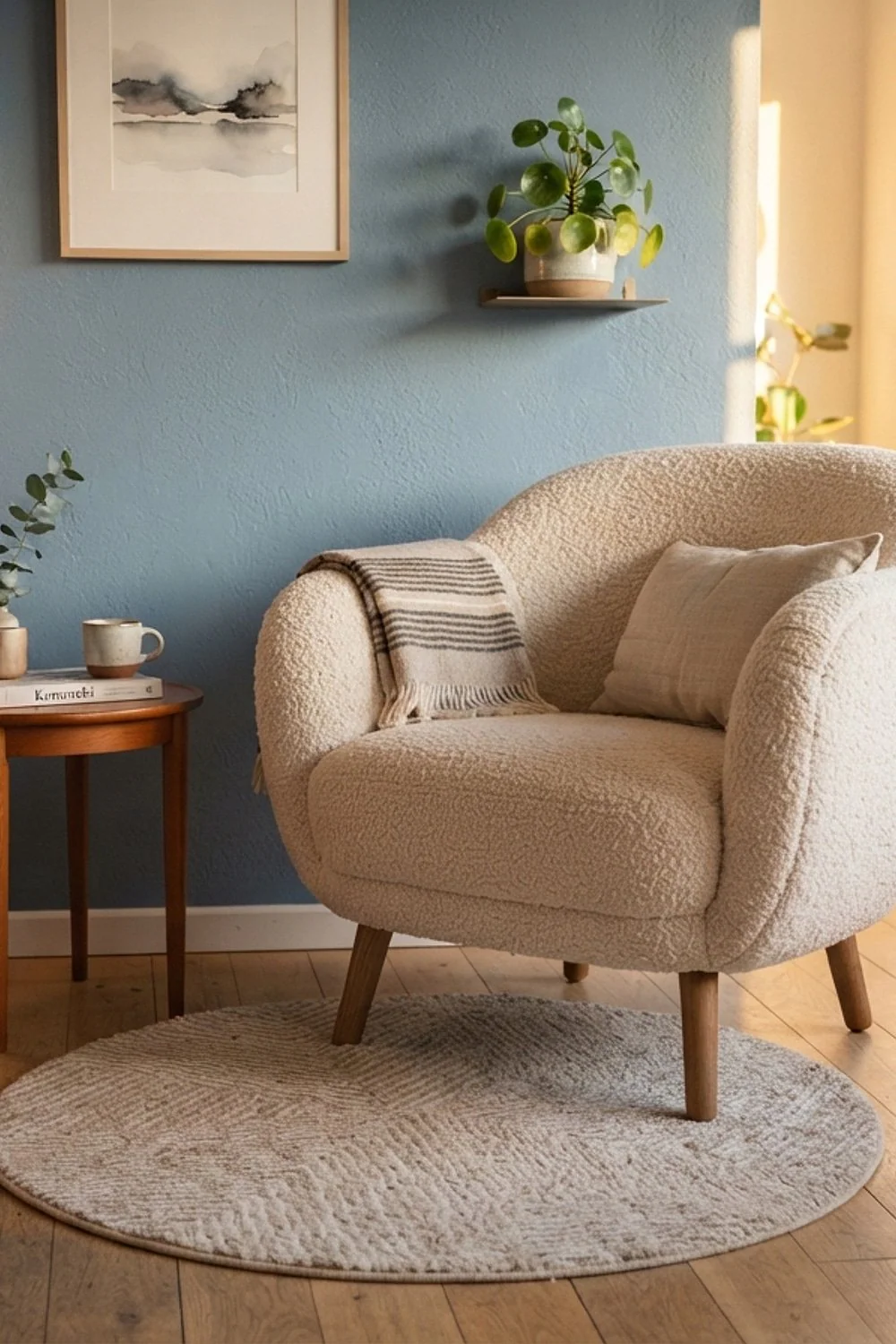
A 3-by-5 rug that sits only under the chair’s front legs makes the nook look like an afterthought. The front two legs should sit on the rug and the back two can float, which means at least a 5-by-8 piece.
Low-pile wool or a flatweave handles the chair swivel without catching. Skip shag, which grabs the base and ruins the glide.
17. A 12-by-20 lumbar pillow, one only

One lumbar pillow, filled with down alternative, fills the gap between your lower back and the shell. Two or three pillows push you forward and make the seat shallower than it is.
Choose a fabric that contrasts with the loops, like a flat linen or velvet, so the pillow doesn’t vanish. Pillows from Parachute or Pottery Barn run about $50-$90 with the insert.
18. An oversized piece of art, 30 inches or taller
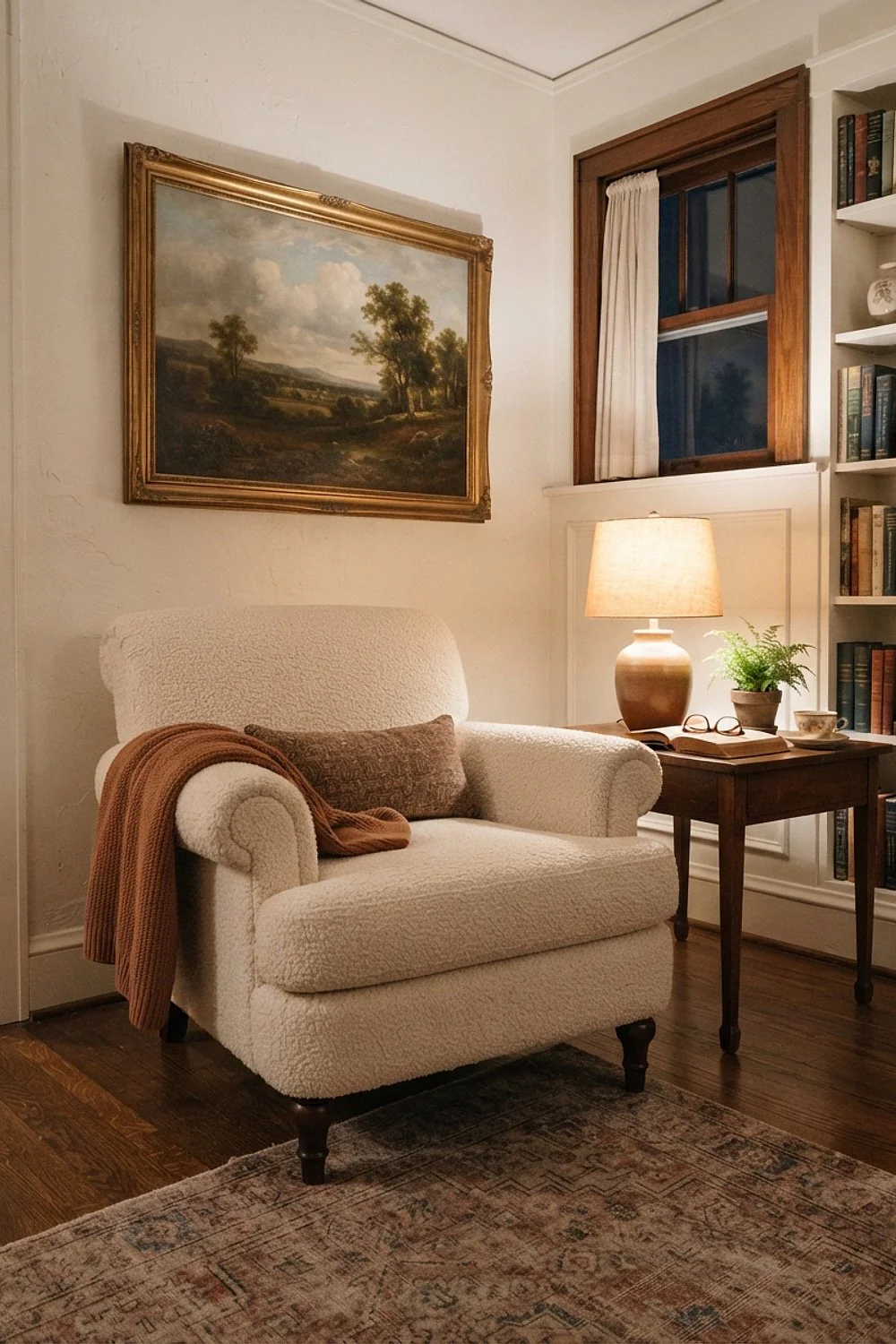
A single large print above the chair makes a small nook feel intentional, because one big shape reads as a deliberate focal point. Several small frames scatter the eye and make the corner feel busy.
Hang it so the center sits about 57 inches from the floor, a bit lower than a gallery wall because you’ll be seated. Leave 6-8 inches between the chair back and the frame bottom, so heads and shoulders never knock it crooked. This works well on a narrow wall where a gallery arrangement would not fit.
Styling tips
19. A chair beside the window, not facing it
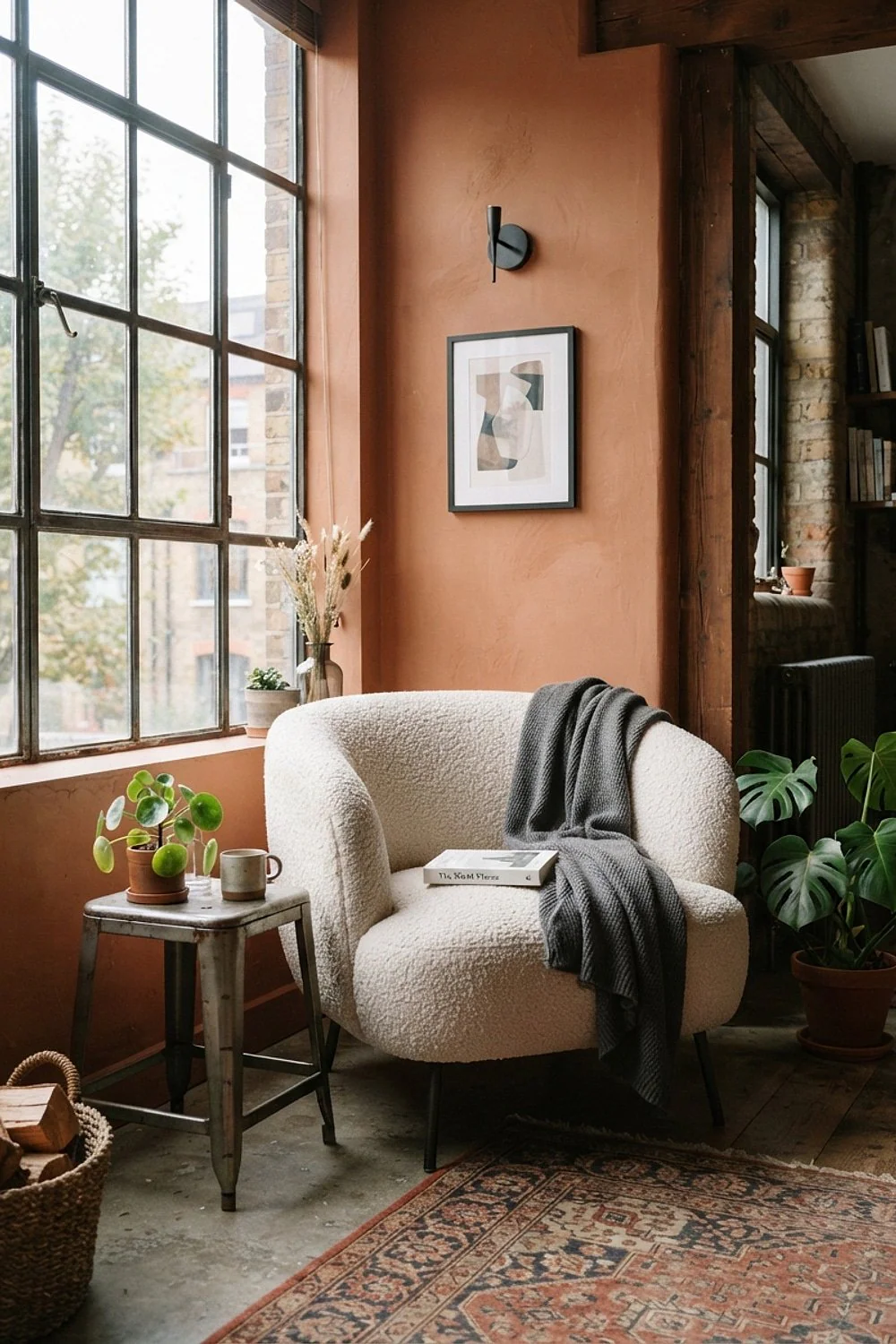
Face the chair toward the room with the window at one shoulder, and you get daylight on the page without glare on a screen or the wall. Staring straight out the window looks lovely and distracts you from the book.
Keep 12-18 inches between the glass and the chair if the window leaks cold. In winter, a drafty sill chills one side of the body faster than you’d expect.
20. A jute or sisal rug layered with a wool one
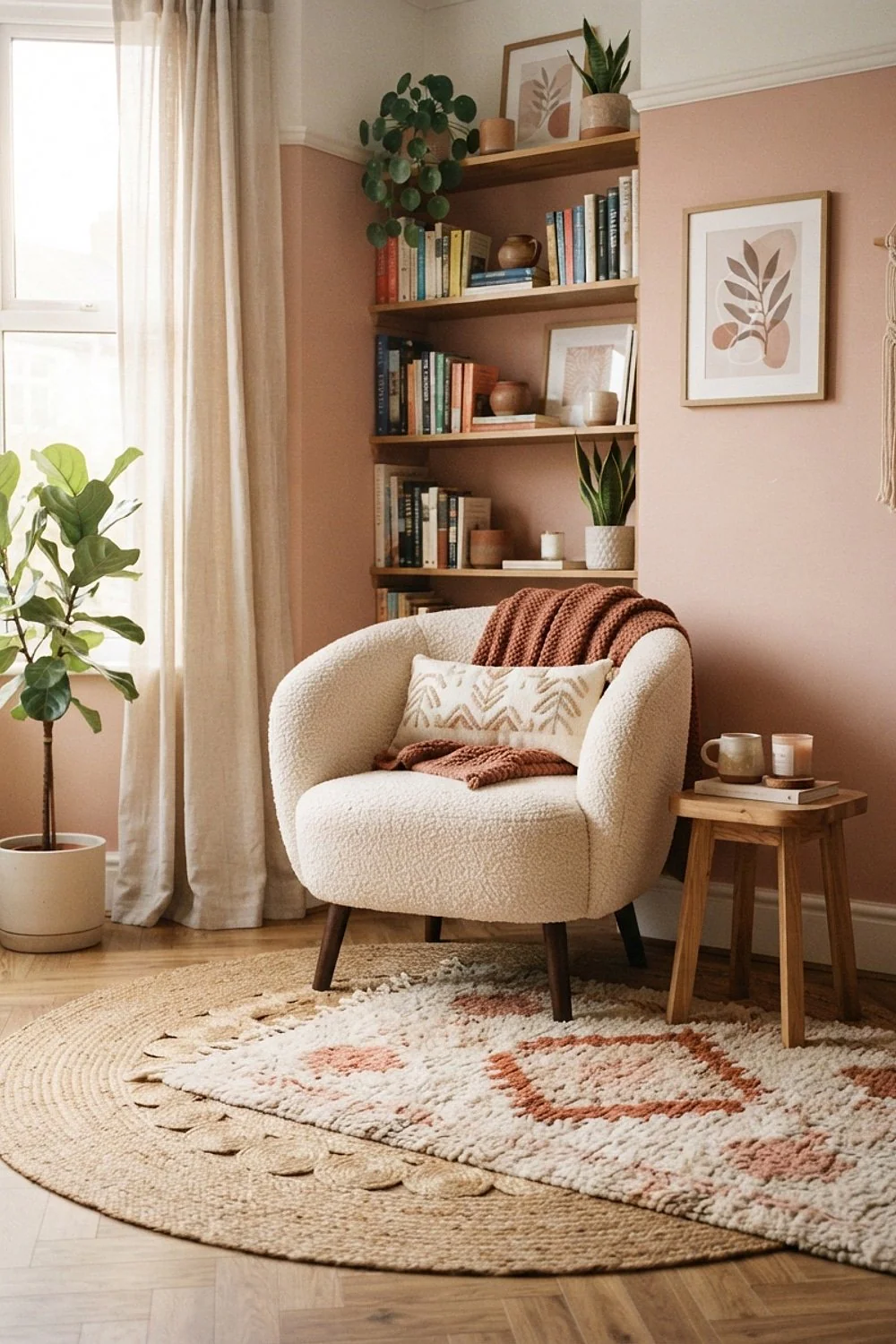
A flat jute rug costs about $100 for 5 by 8 and gives a coarse, dry contrast to the soft boucle, so the chair’s texture stands out. Layering a smaller wool rug on top adds warmth under bare feet.
Jute sheds a little at first and doesn’t love spills, so it suits a bedroom nook more than a busy hallway, and it fits a budget that cannot stretch to a large wool rug. Vacuum without the beater bar, which snags and frays the fibers.
21. One plant, at least 3 feet tall

Fourteen inches across and finished in matte ceramic, one olive tree or rubber plant pot fills the dead air above the arm. Three small plants on a shelf read as clutter.
Place it where it gets bright indirect light, and rotate the pot a quarter turn every two weeks. A plant leaning toward the window will lean over the chair.
22. A rust or terracotta throw for contrast
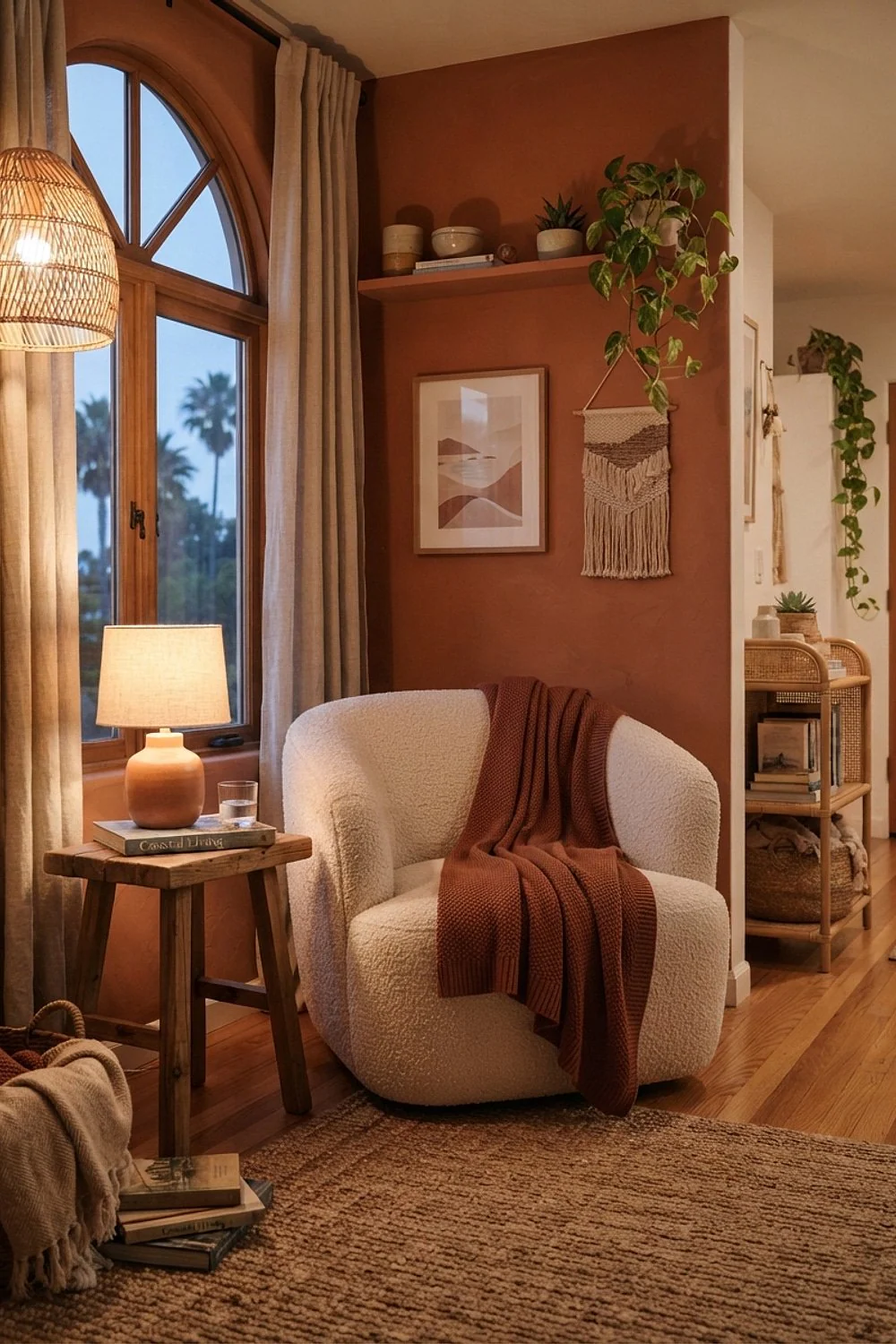
Warm accents like a rust wool throw stop an all-neutral nook from going flat, so pick just one. The orange pulls against ivory the way a ripe persimmon sits against a white plate.
It is an easy, low-cost change for a cream or gray room, and a throw can be swapped out each season. Keep it to one accent color. A second competing shade, say mustard beside rust, makes the corner look like a catalog page.
23. A small tray on the chair arm for tea and glasses

Measuring about 8 by 12 inches, a flat wooden tray sits on a wide chair arm and keeps a mug from tipping into the loops. Liquid soaks into boucle faster than it does into smooth weaves, and rings are hard to lift.
If the arms are curved, use a clip-on tray or put a side table within reach. A drink balanced on a round arm always ends up on the cushion.
Walking through the setup
A boucle reading nook chair pairs best with textures that behave differently from it: smooth leather, flat linen, coarse jute, polished wood. When everything in the nook is nubby, the loops stop reading as a feature and start reading as noise.
- Keep one soft texture, one hard texture and one rough texture within sight of the chair.
- Repeat the chair’s color once in a pillow or a ceramic piece.
- Match metals across the lamp, the frame and the chair legs.
And leave a bare patch of wall. A nook with every surface dressed feels crowded in a way that undoes the whole point of a quiet corner.
What to buy first
A boucle reading nook chair is the trend piece that has stayed because the shape underneath is classic. The frame, the foam and the swivel base are where the money should go, since those parts are what fail first.
Spend on the structure: kiln-dried hardwood frames, high-density foam and a metal swivel plate. Save on the pillows, the throw and the tray, which you’ll swap with the seasons anyway.
- Invest: the chair frame, the reading lamp and the rug.
- Rent or thrift: planters, trays, baskets and art prints.
- Trend: bright color-block upholstery and extreme oversize shapes.
Rookie errors
Buying online without measuring is the top mistake, followed closely by choosing a fabric for the showroom light instead of your own. A chair that looks cream in the photo can read yellow at 4pm.
- Pushing a deep chair into a shallow alcove.
- Using a cool white bulb over warm fabric.
- Ignoring where a pet will sit.
- Skipping the side surface for a drink or book.
Each of these takes about 10 minutes to check and saves a return shipment.
Closing thoughts
A boucle reading nook chair works when the chair, the light and a place for your hands are all sorted before the first page. Get those three right and the remaining choices become small, forgiving decisions.
Save or pin this list so it’s handy when you start shopping. Then measure your corner first, including the doorway, and start with the single idea that solves your biggest gap, whether that’s the lamp or the seat height.
Frequently Asked Questions
How big should a boucle reading nook chair be for a small corner?
Aim for a width of 28-30 inches and a depth under 32 inches. That leaves enough room to enter and exit without brushing the wall, even in a 4-foot alcove. Measure the doorway diagonal too before ordering.
How do you clean boucle fabric?
Vacuum with a soft brush attachment, then dab stains with a damp white cloth and a drop of mild soap. Blot, never rub, because friction crushes the loops. Check the care tag for a W or S code before using any liquid.
Does a boucle reading nook chair survive pets and kids?
It can, if the weave is tight and the fiber is polyester or a performance blend. Loose wool loops snag easily on claws and zippers. A tight small-loop fabric rated for 30,000 double rubs holds up much better.
Where should a reading chair sit in a bedroom?
Put it near a window, turned about 30 degrees toward the room, with a lamp on the opposite side. That position gives daylight over the shoulder and keeps the chair out of the bed’s traffic path. Leave 30 inches of walkway.


