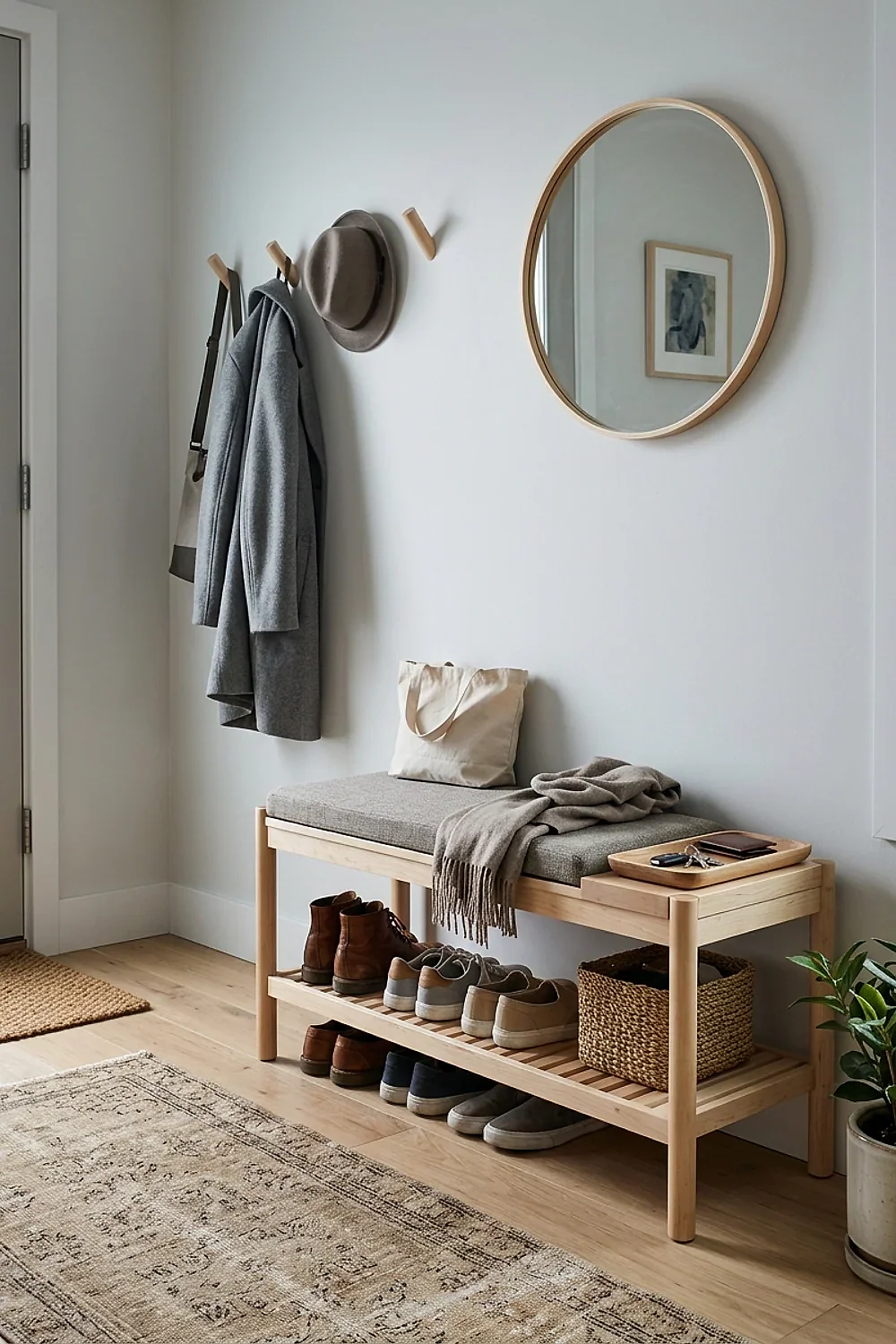
21 Small Entryway Storage Bench Styles That Endure
By the time this list ends, a narrow stretch of wall by the front door can hold a bench that looks as right in 2045 as it does today. A small entryway storage bench earns that kind of longevity from proportion, solid joinery, and a silhouette that a few centuries of hallways have already tested.
Twenty-one styles follow. Each comes with the history that explains why it keeps returning, plus the one detail that decides whether it works in a tight hall.
Why these small entryway storage bench styles never age
The short answer to what works: a bench 14 to 18 inches deep, 17 to 19 inches tall at the seat, and 36 to 48 inches wide, built from solid wood or good veneer over plywood. Storage goes underneath, as a lift lid, an open shelf, or baskets.
Those numbers haven’t moved much since the Victorians started furnishing front halls. Every style below follows them, and each adds its own history.
1. Shaker slat-front bench
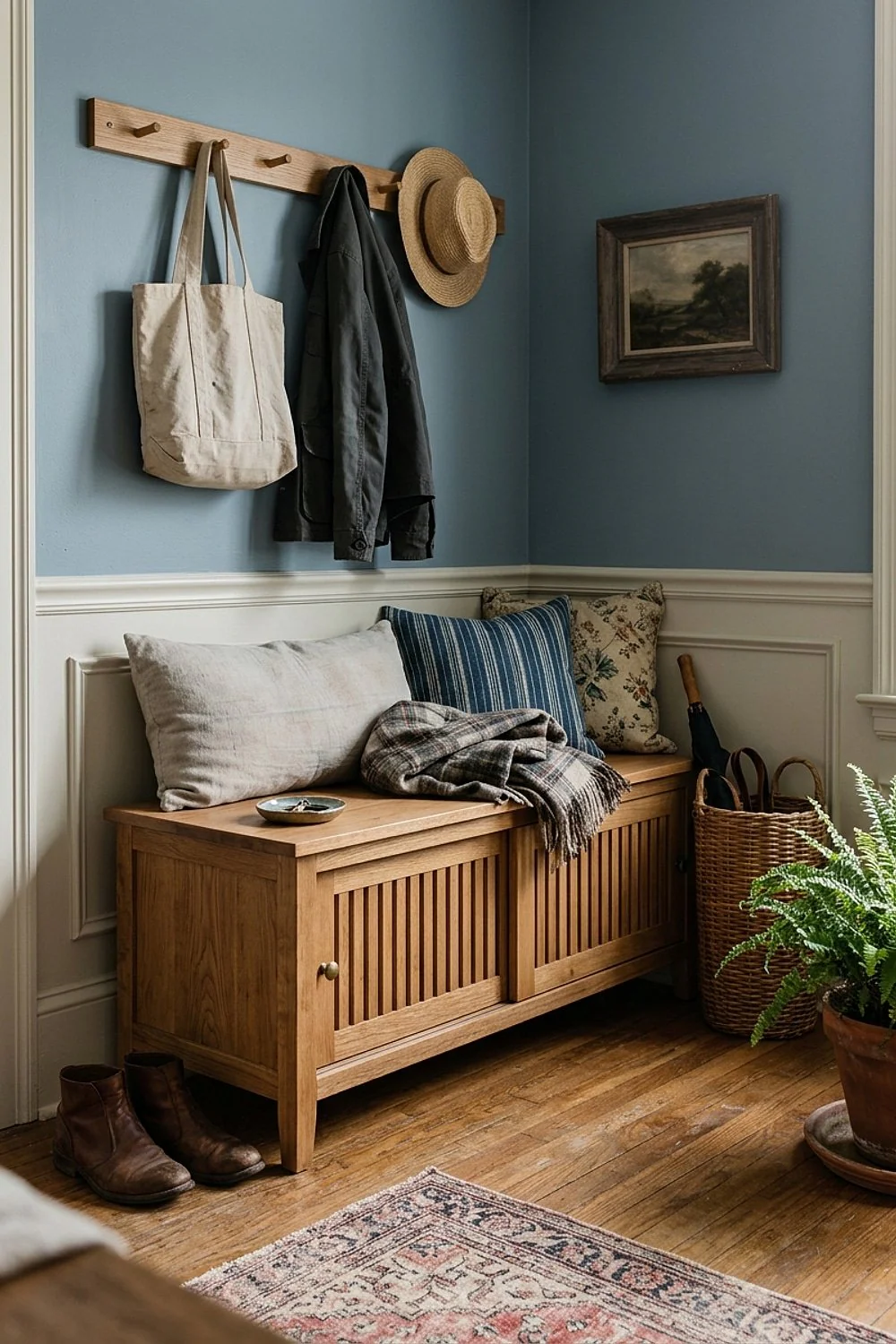
Shaker communities in New York and New England built plain benches from the late 1700s, with tapered legs and no carving, because ornament counted as vanity. The result suits a hall under five feet wide, where visual quiet matters more than drama.
Clear-finished pine ages to honey. Painted versions chip first at the front edge, so choose a hard oil finish if the bench will meet boots daily.
2. Quarter-sawn oak mission bench
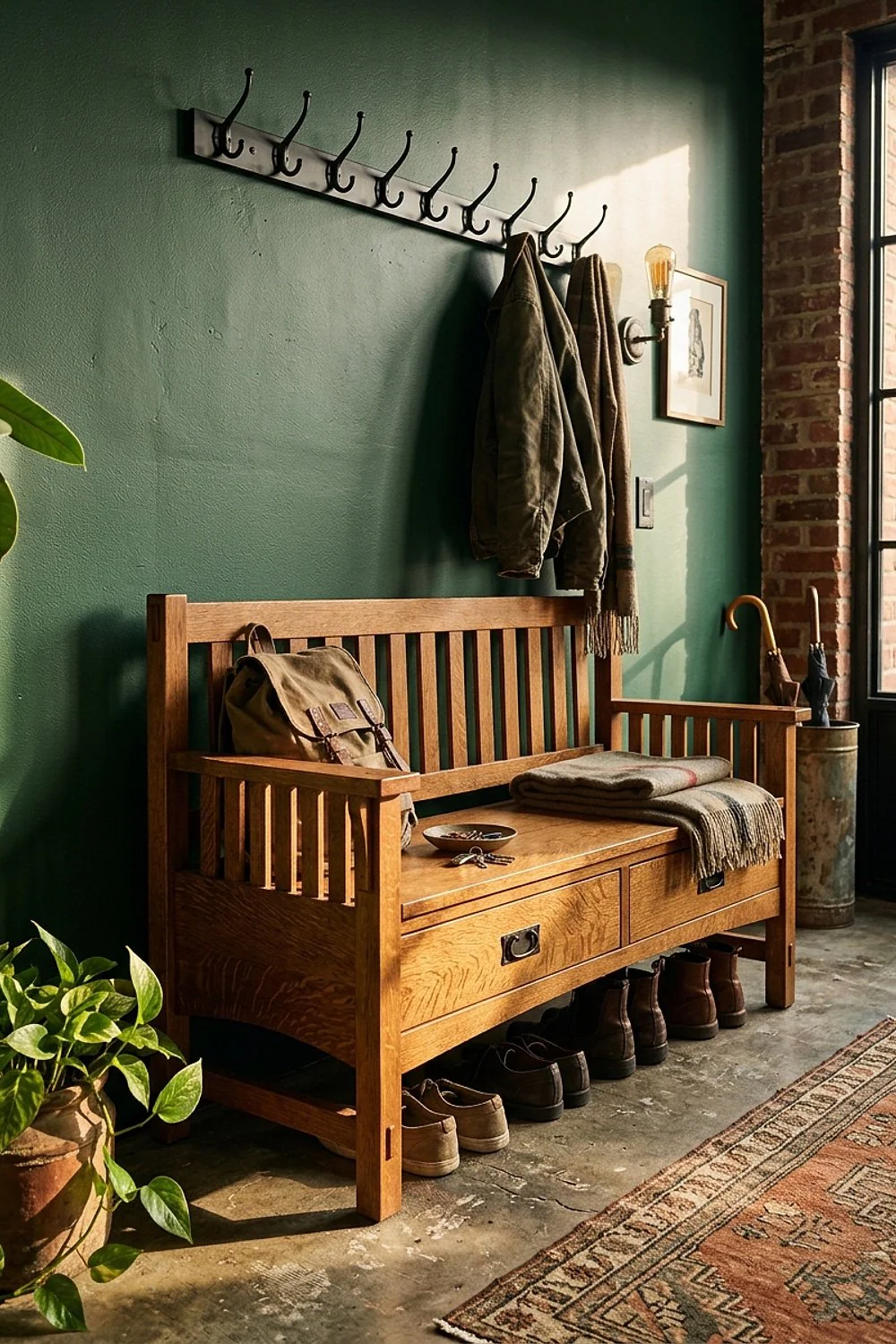
Gustav Stickley and the Arts and Crafts makers of the early 1900s put exposed mortise-and-tenon joints on show, and quarter-sawn oak displays its ray flecks like watered silk. This bench belongs in a home with trim, plaster, or any older bones.
Check the weight before buying. A real oak bench of 40 inches weighs 35 pounds or more, which is the point: it won’t walk across the floor when someone sits to pull on a boot.
3. Lift-lid chest bench
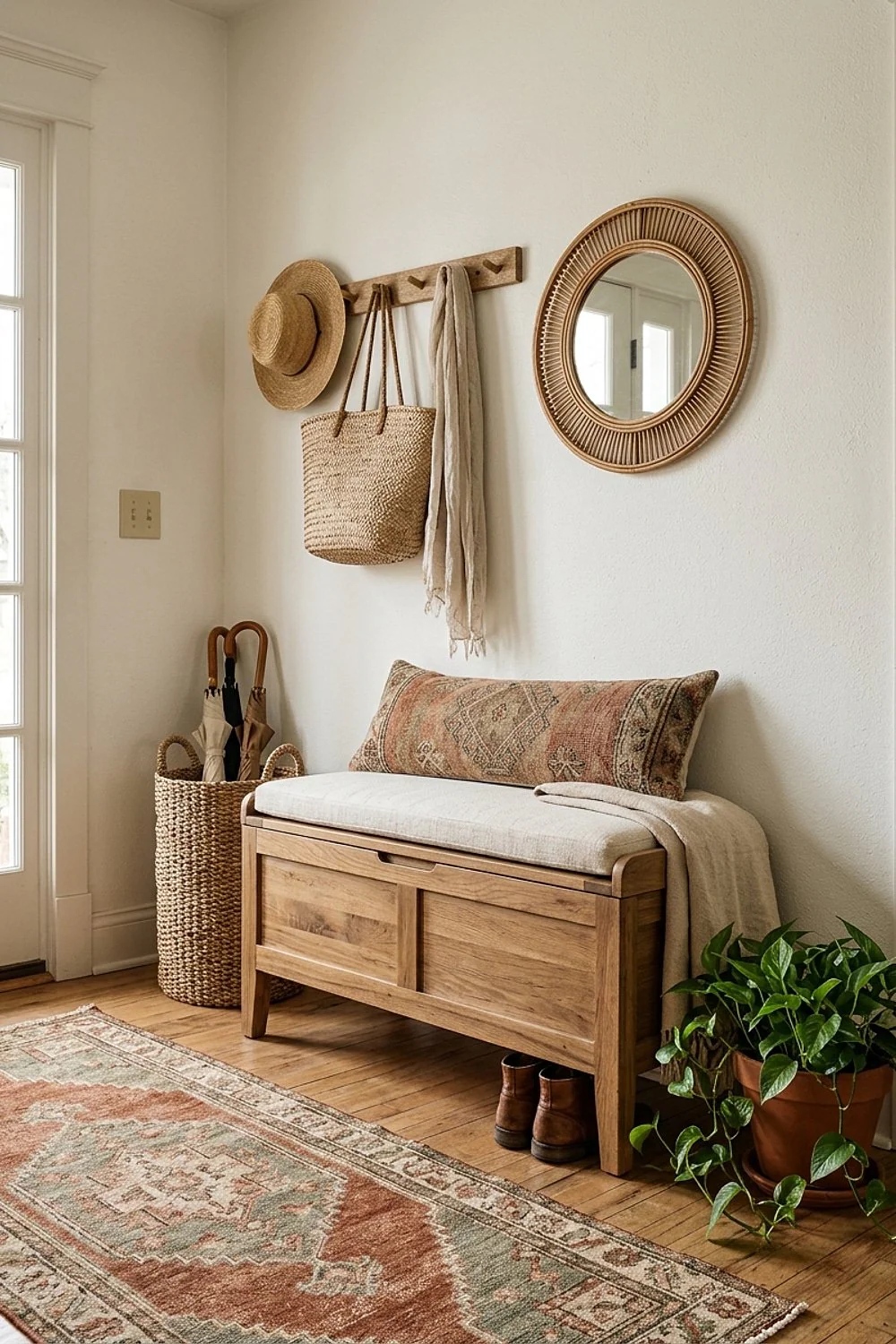
The storage chest is one of the oldest furniture forms, descended from medieval coffers that doubled as seats. Today it swallows a winter’s worth of mittens and dog leads behind one clean front, ideal for families with no closet near the door.
A soft-close hinge pair costs about $12 and saves fingers. Skip any chest without a lid stay, because a falling lid is the single most common complaint.
4. Tufted bench in performance fabric
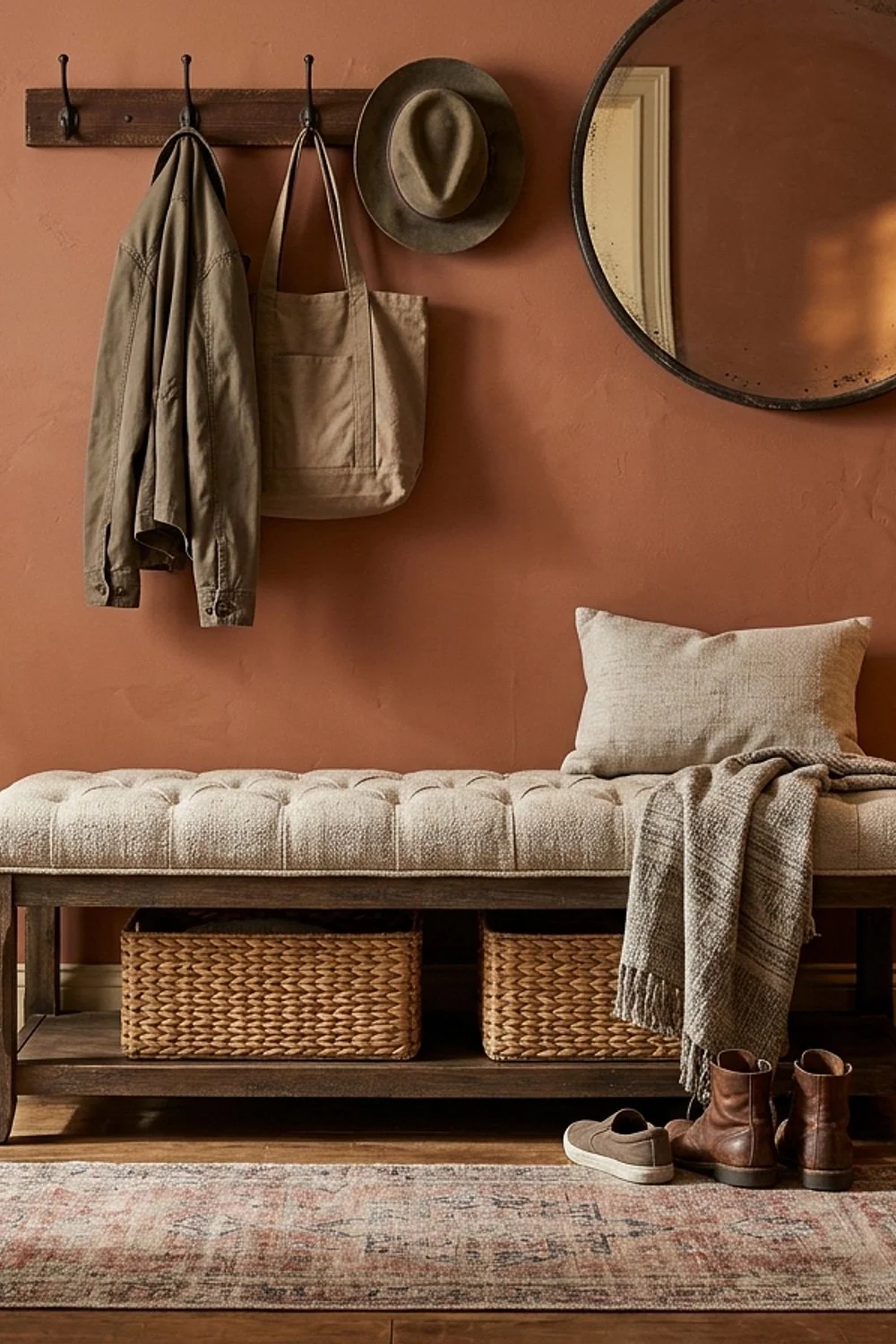
Upholstered hall seats date to the Georgian period, when buttoned wool covered the long benches of country houses. A tufted top at 2 to 3 inches of foam gives you somewhere comfortable to lace shoes, and suits older sitters especially.
Choose a tight weave rated for 30,000 double rubs or more. Loose linen on an entry bench looks wrinkled by March, and it’s the first thing wet coats will ruin.
5. The 36-inch narrow bench
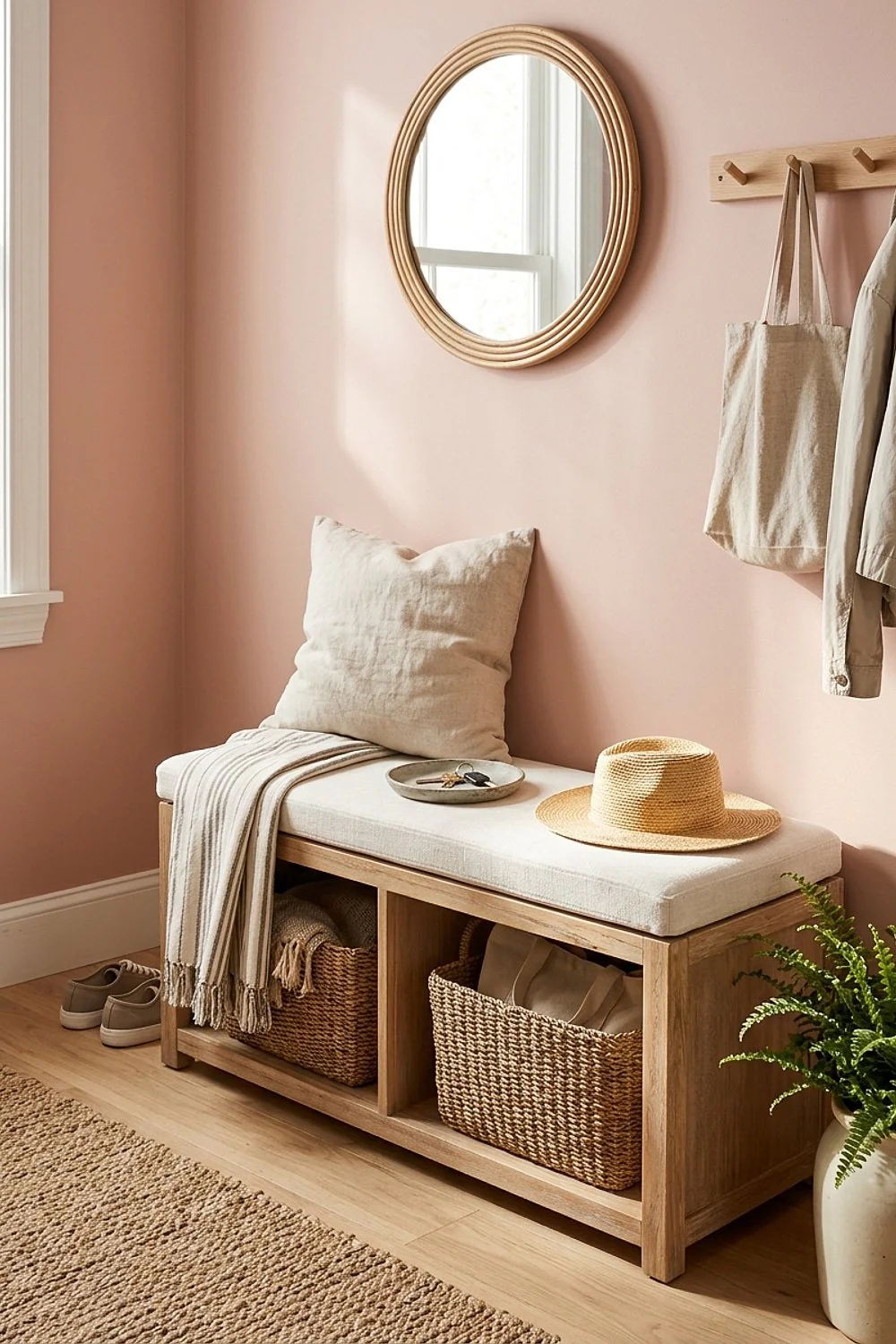
Narrow halls under 40 inches wide can still take a bench if it stays at 12 to 14 inches deep. The footprint leaves 26 inches of walkway, the minimum for passing without turning sideways.
Wedging a 20-inch-deep bench into a hall like that is the toaster-in-a-bathroom-sink of furniture: it fits, technically, and nobody is happy. A shallower top also stays clear enough to use, so it often holds more in practice.
6. Cubby bench with woven baskets
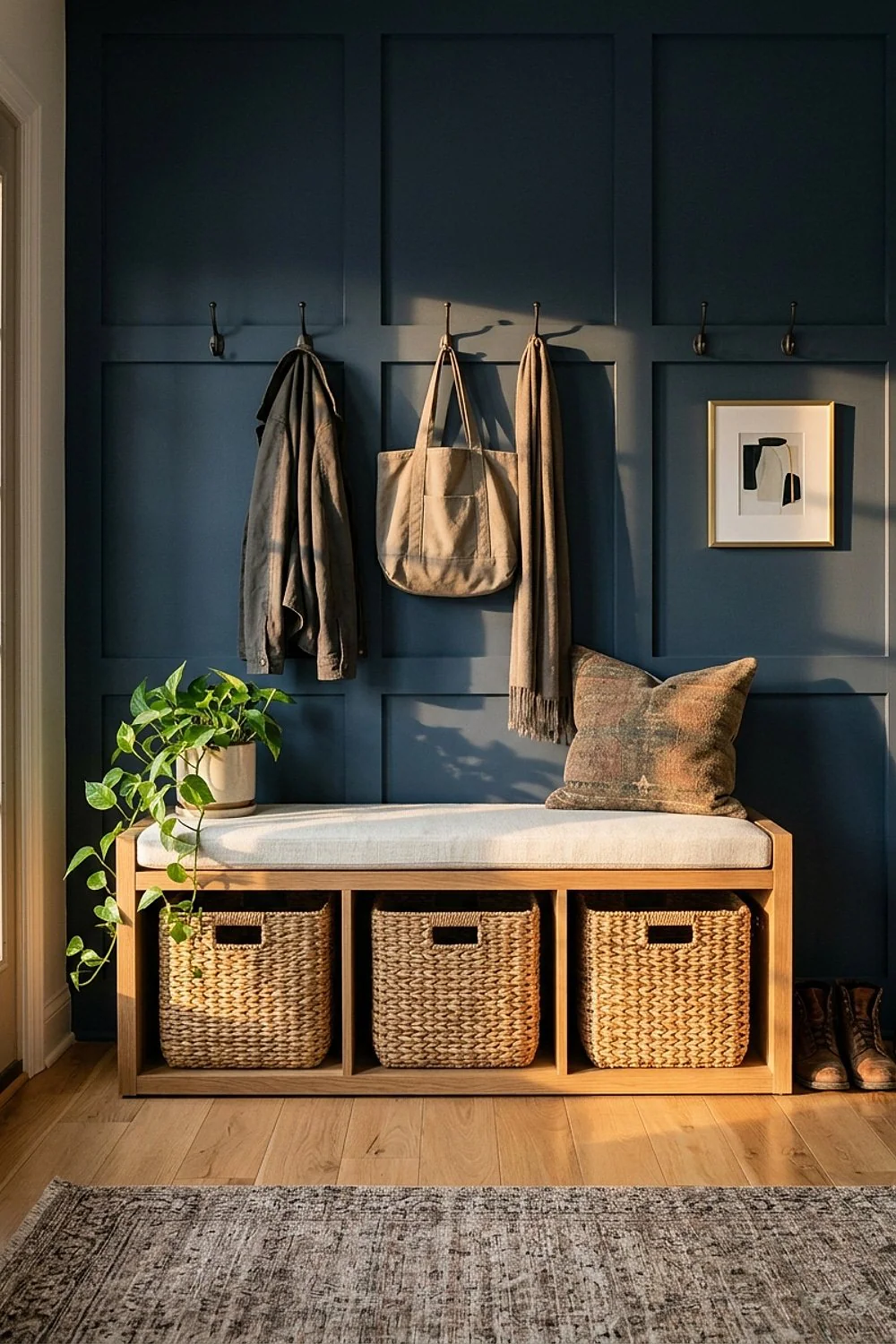
Cubby benches grew out of mudroom lockers and boot-room shelving in English and American country houses. Two or three open bays hold lidded baskets, and each family member gets a bay, which stops pile-ups at the door.
Seagrass baskets run roughly $18 to $30 each and last for years, though they shed fibers for the first month. Measure each bay before buying, since baskets even half an inch too wide jam in their slots.
7. Painted pine bench, lightly worn
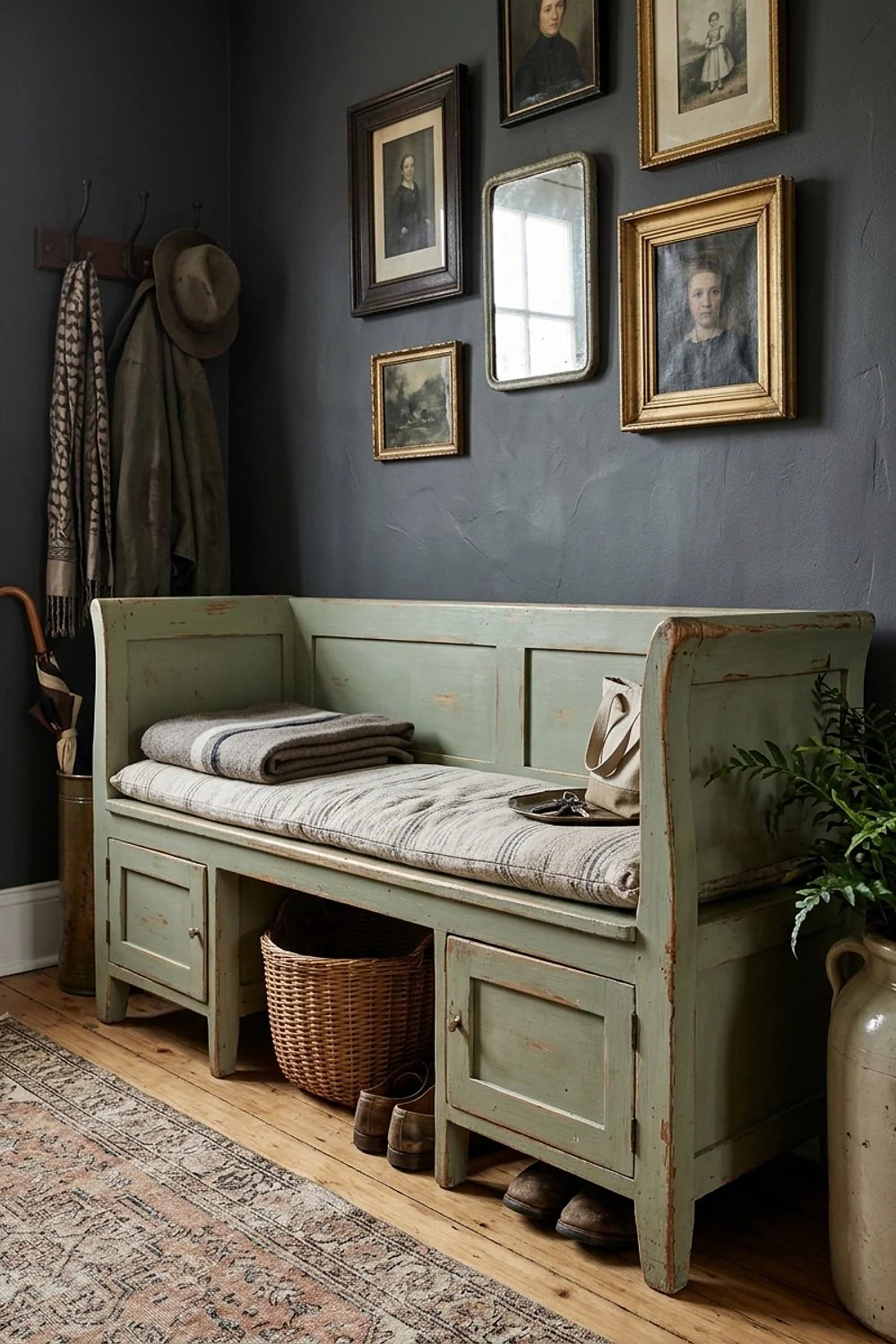
Old painted country benches get their charm from decades of real handling, with paint rubbed down at corners and seat edges. A new bench with a gentle, uneven wear pattern gives the same quiet confidence in a farmhouse hall.
The common mistake is heavy pre-distressing, where every edge is sanded to the same degree. It reads as factory work from across the room, and it never looks like use.
8. Bench beneath a window
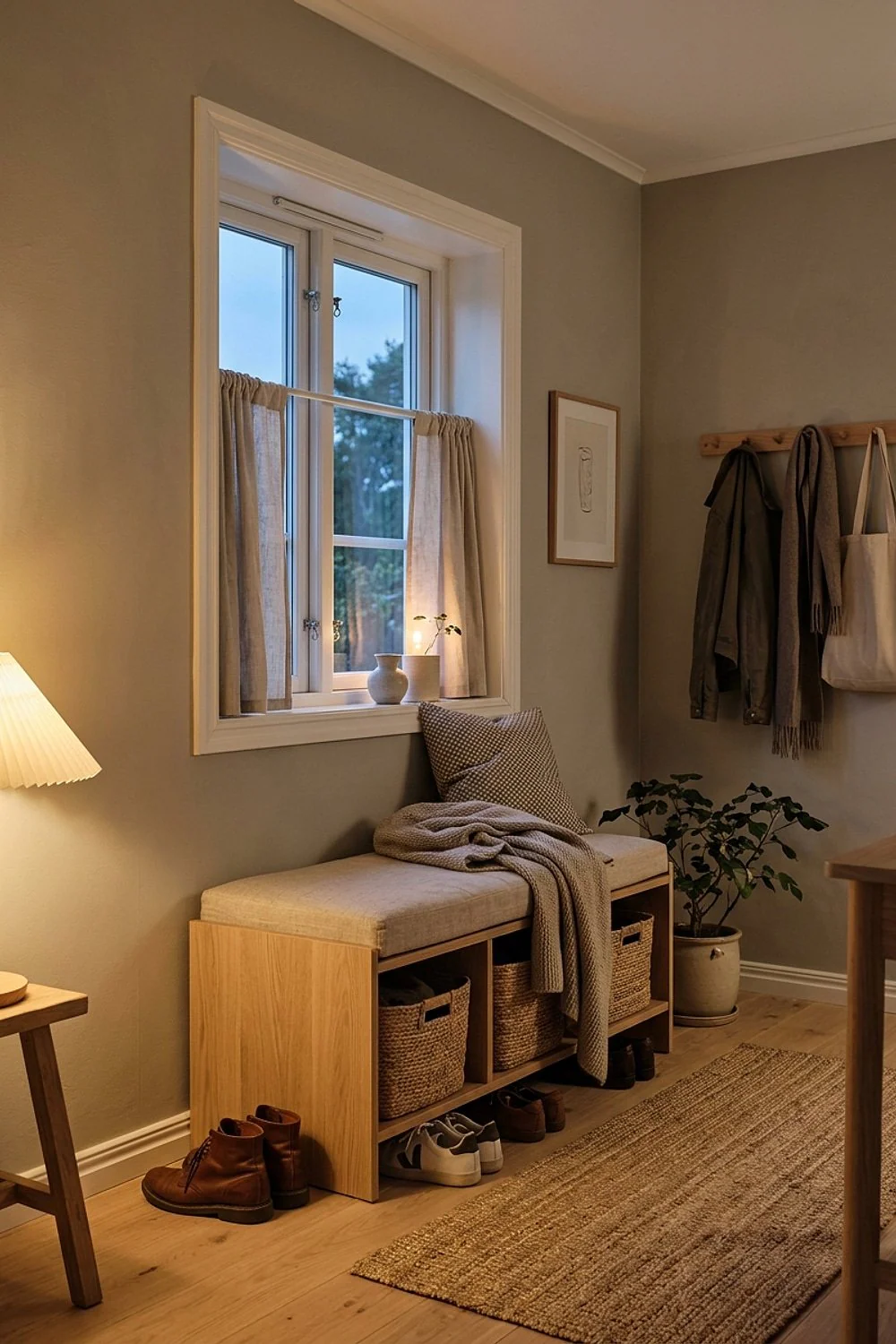
Window benches trace back to the English window seat, and in an entry they catch late light beautifully. At 4pm in autumn, a low west window rakes across the wood grain and turns a plain oak top the color of toasted bread.
Keep the window sill at least 4 inches above the seat back so the glass doesn’t hit shoulders. And watch for direct sun, which fades dark upholstery within two summers.
9. Corner bench with an L-shaped return
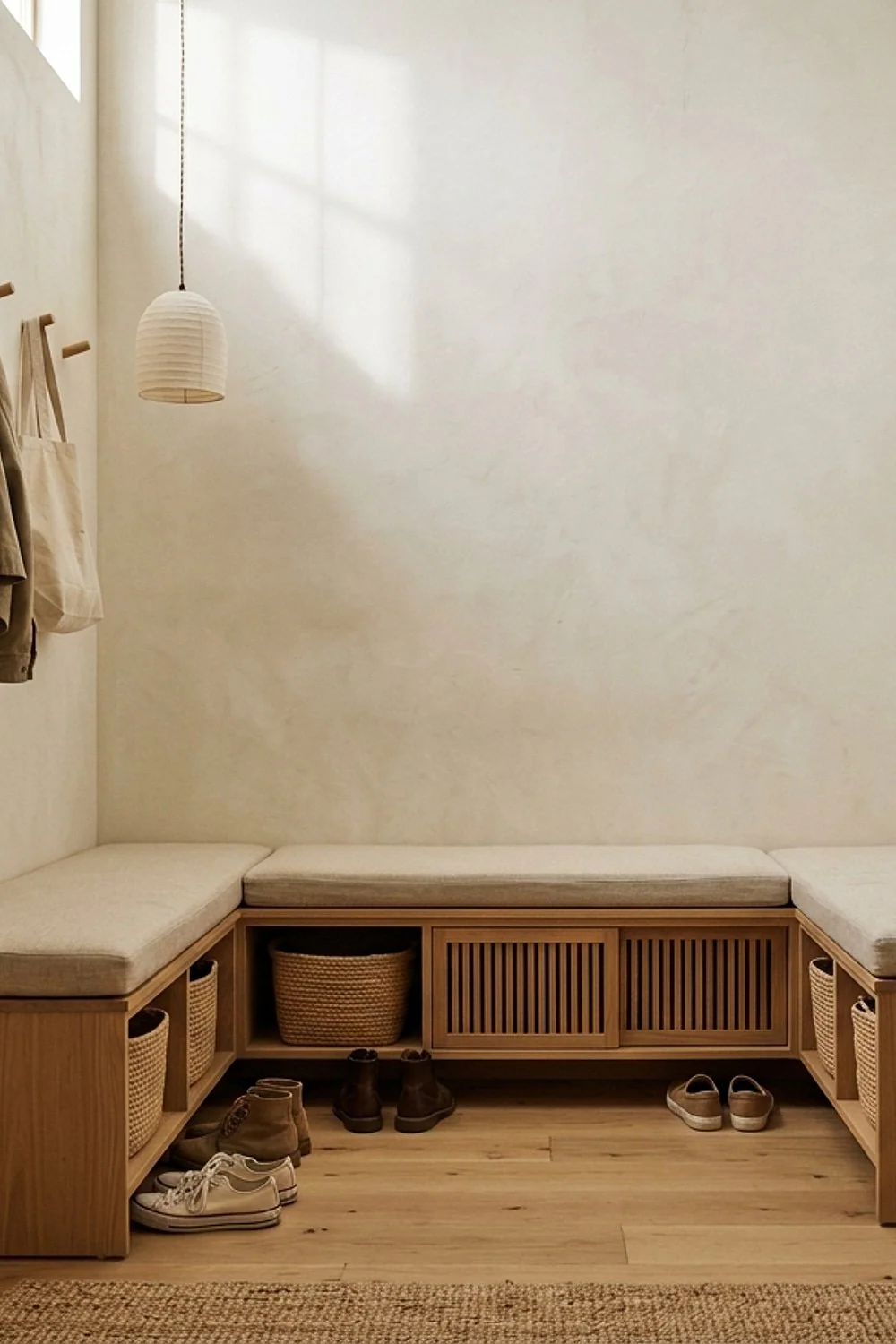
Where a hall bends or a door opens against a side wall, an L-shaped bench uses a corner that would otherwise gather dust. Built-in banquettes of the 1920s used the same trick in breakfast nooks.
This is the layout for entries at least 5 feet square, with enough room for the door to swing clear. In anything tighter, the return eats the walkway, so stay with a straight bench.
10. Navy lacquered bench
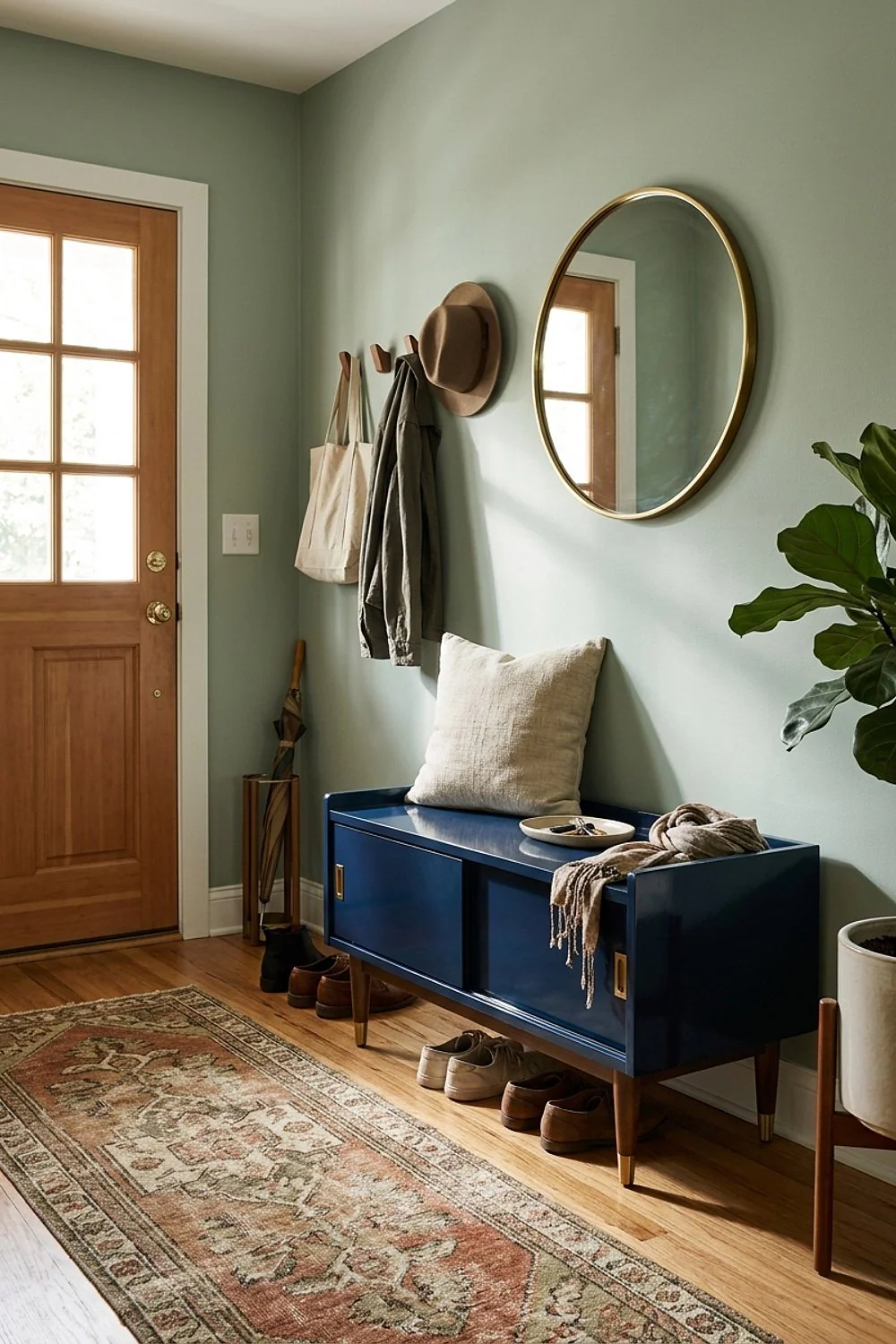
Deep blue-black lacquer has been a furniture finish since Chinese export pieces reached Europe in the 1600s, and it still anchors a pale hall without fuss. A navy such as Benjamin Moore Hale Navy hides scuffs better than white and looks richer than black.
Lacquer only behaves on a properly sanded, primed surface. Anything less shows brush marks under the entry light, so go with a pro-sprayed finish if the bench is custom.
11. English hall settle with a high back
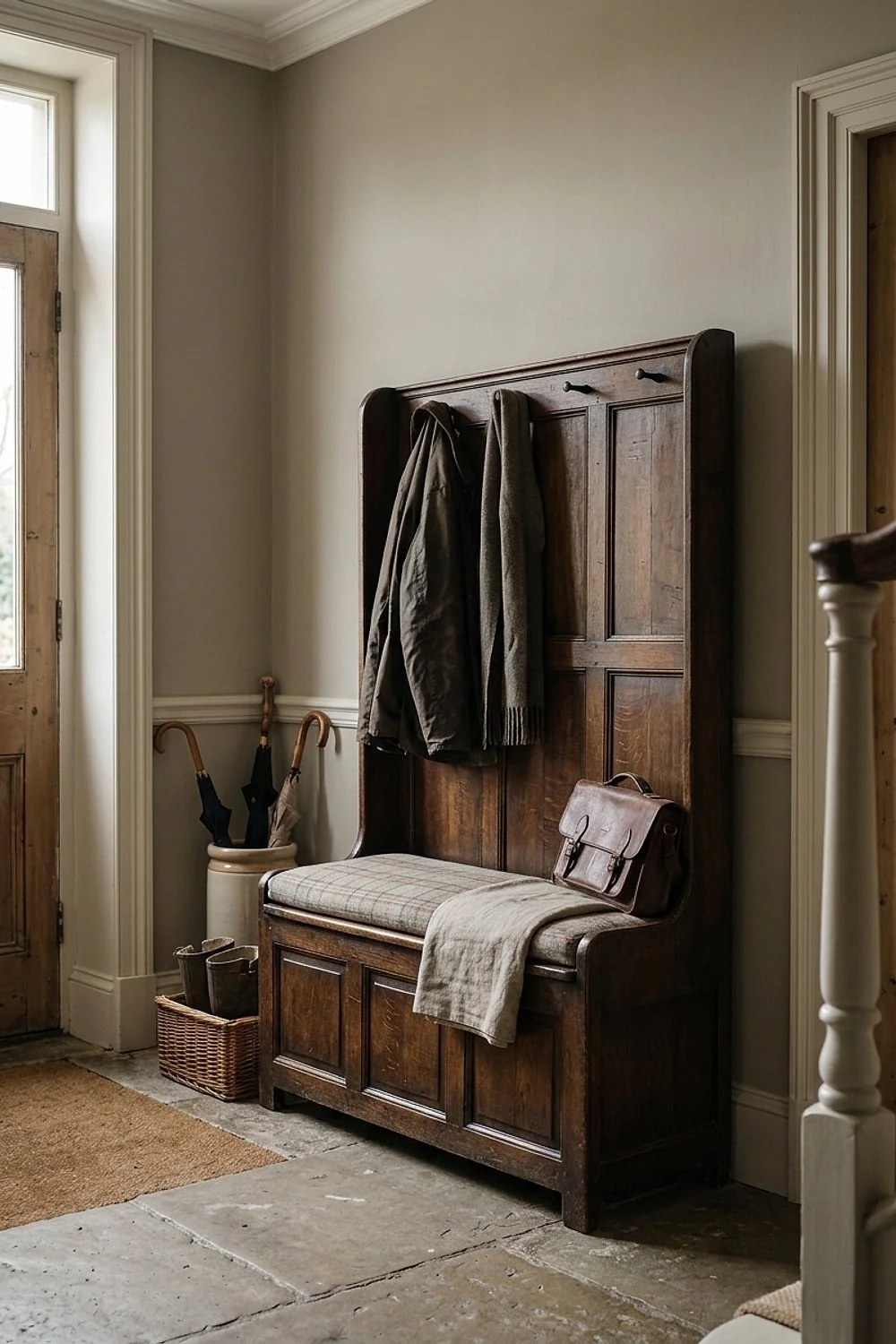
Medieval settles had tall backs to block door drafts, and the Victorians turned them into hall furniture with hooks and a seat that opens. A 42-inch-wide settle suits tall, narrow entries where wall height is the only generous dimension.
Check the seat height before committing. Many antique settles sit at 15 inches or lower, which is hard on knees, so a 2-inch cushion is a reasonable fix.
12. Cane-seat bench in ash or beech
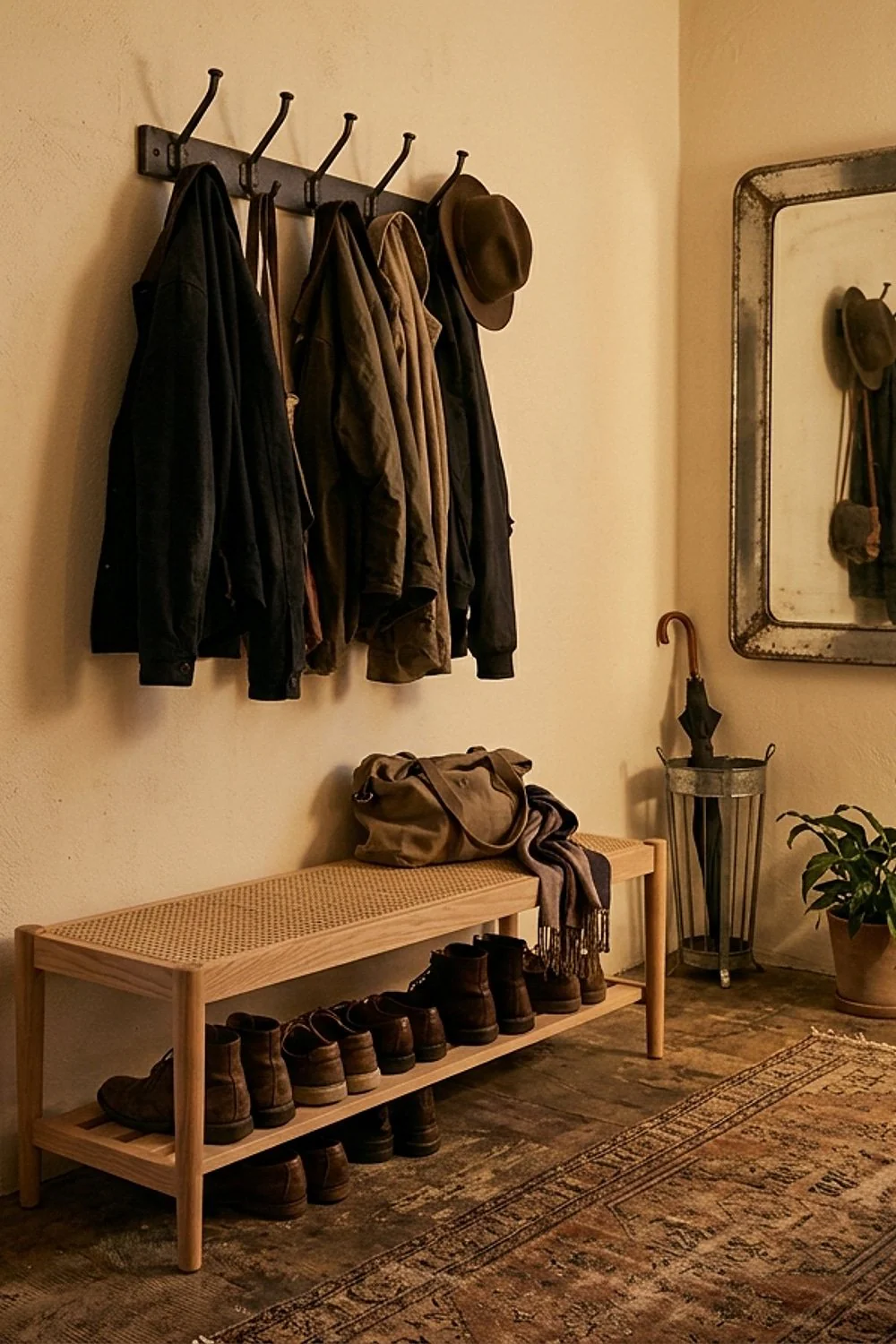
Woven cane seats came into fashion in the 1860s, when Michael Thonet’s bentwood chairs made them the café standard. A cane top breathes, lets wet coats dry, and keeps a small hall from feeling heavy.
Secondhand versions run about $90 to $200 and are often sturdy. Press the cane gently before buying: it should spring back, and any sag means a full re-cane.
13. Open-slat bench with a shoe shelf
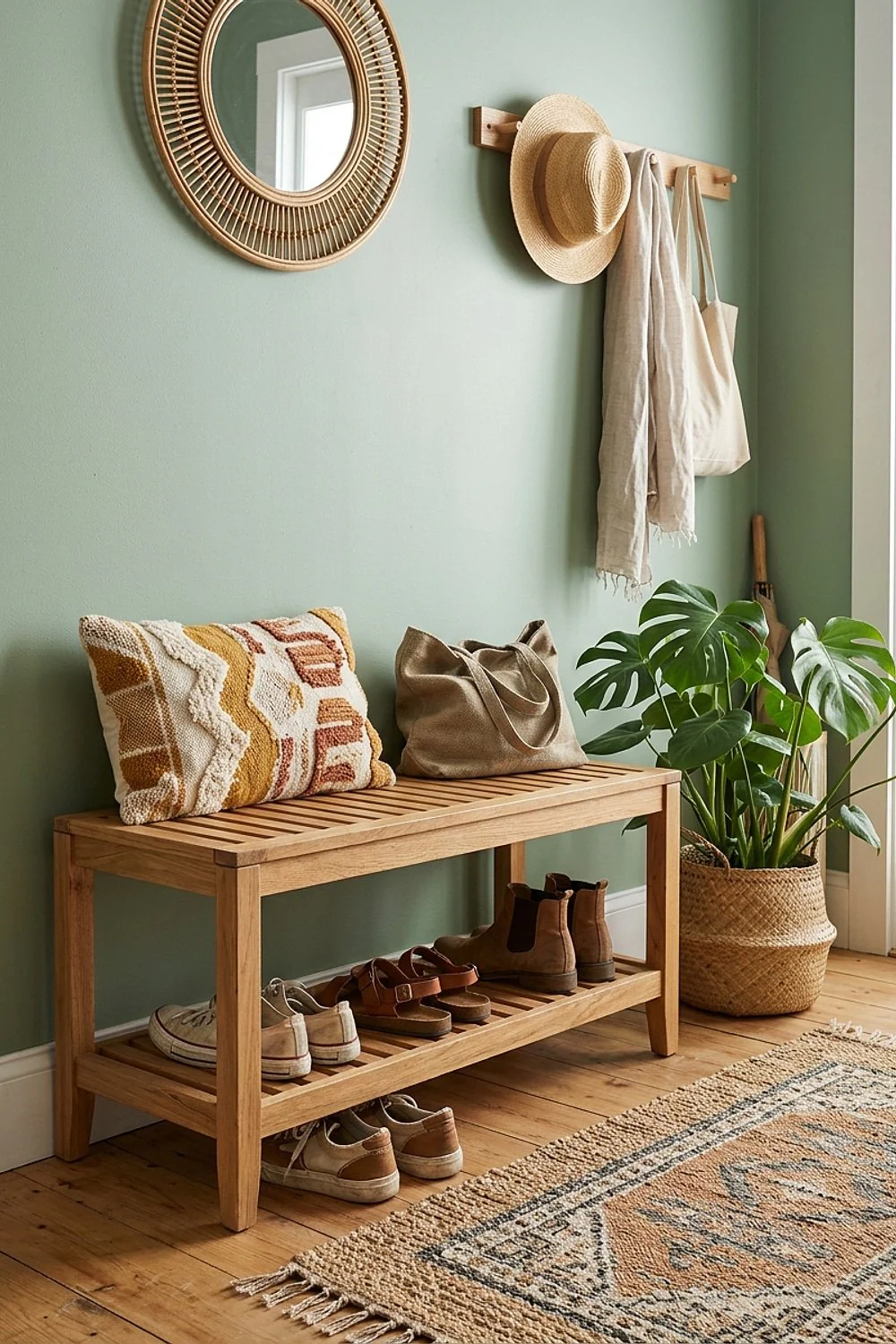
Japanese genkan entries have always separated shoes from the living floor, and a slatted bench with a low shelf follows the same logic. It suits households that remove shoes every time and need air around wet soles.
Here’s a counterintuitive point: open storage beats a closed chest for damp boots, because trapped moisture breeds mildew in a lidded box within a week or two of rain.
14. Saddle-leather topped bench
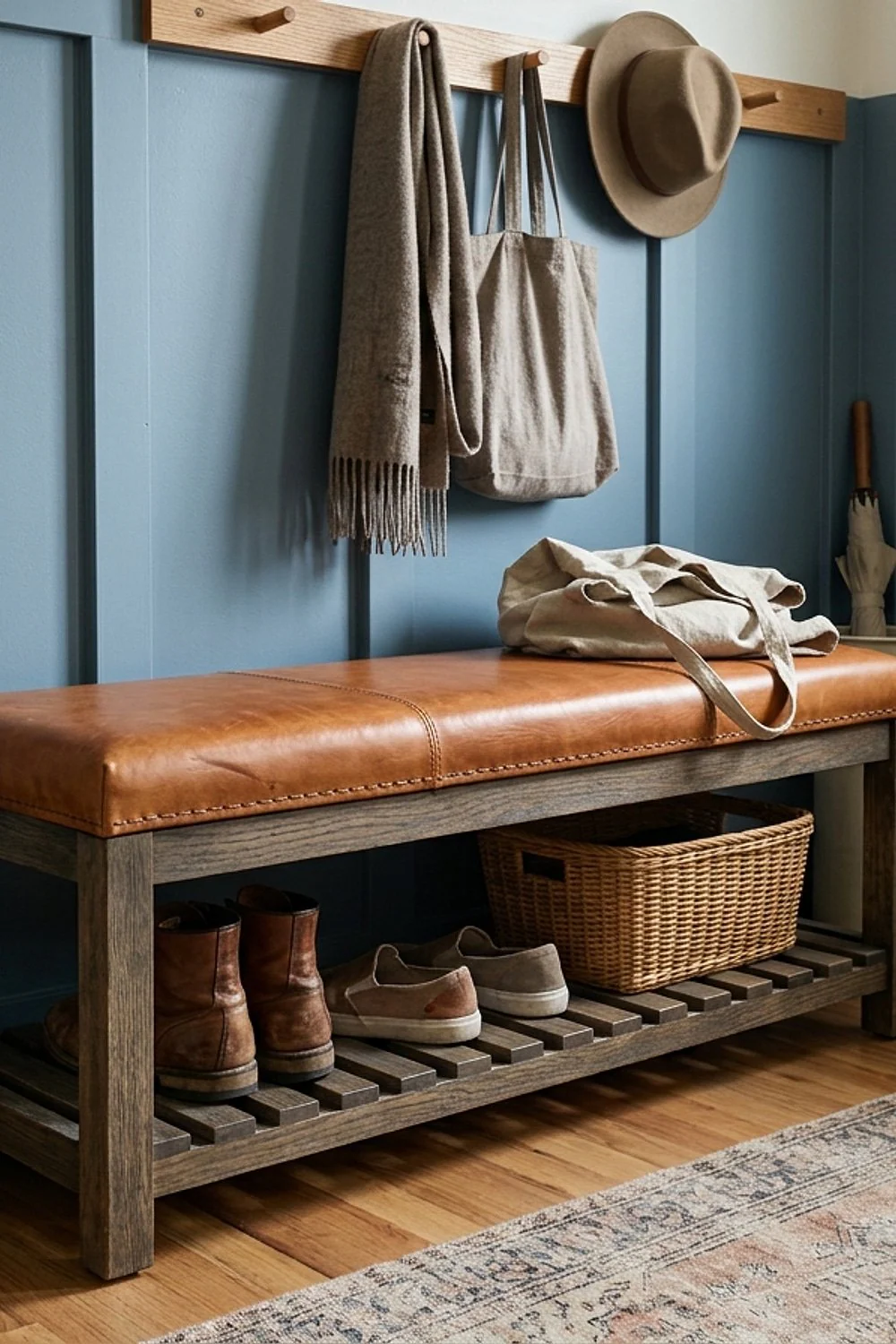
Leather has covered English club seats since the 1700s, and a veg-tanned top softens beautifully, with a dark patina at the front edge where people sit most. It suits adult households with a taste for materials that improve.
The trade-off is honest. Leather shows water spots and pet claws, so it fits a quiet entry better than a chaotic family one. Look for full-grain hide, never bonded leather, which flakes in two years.
15. Wall-mounted floating bench
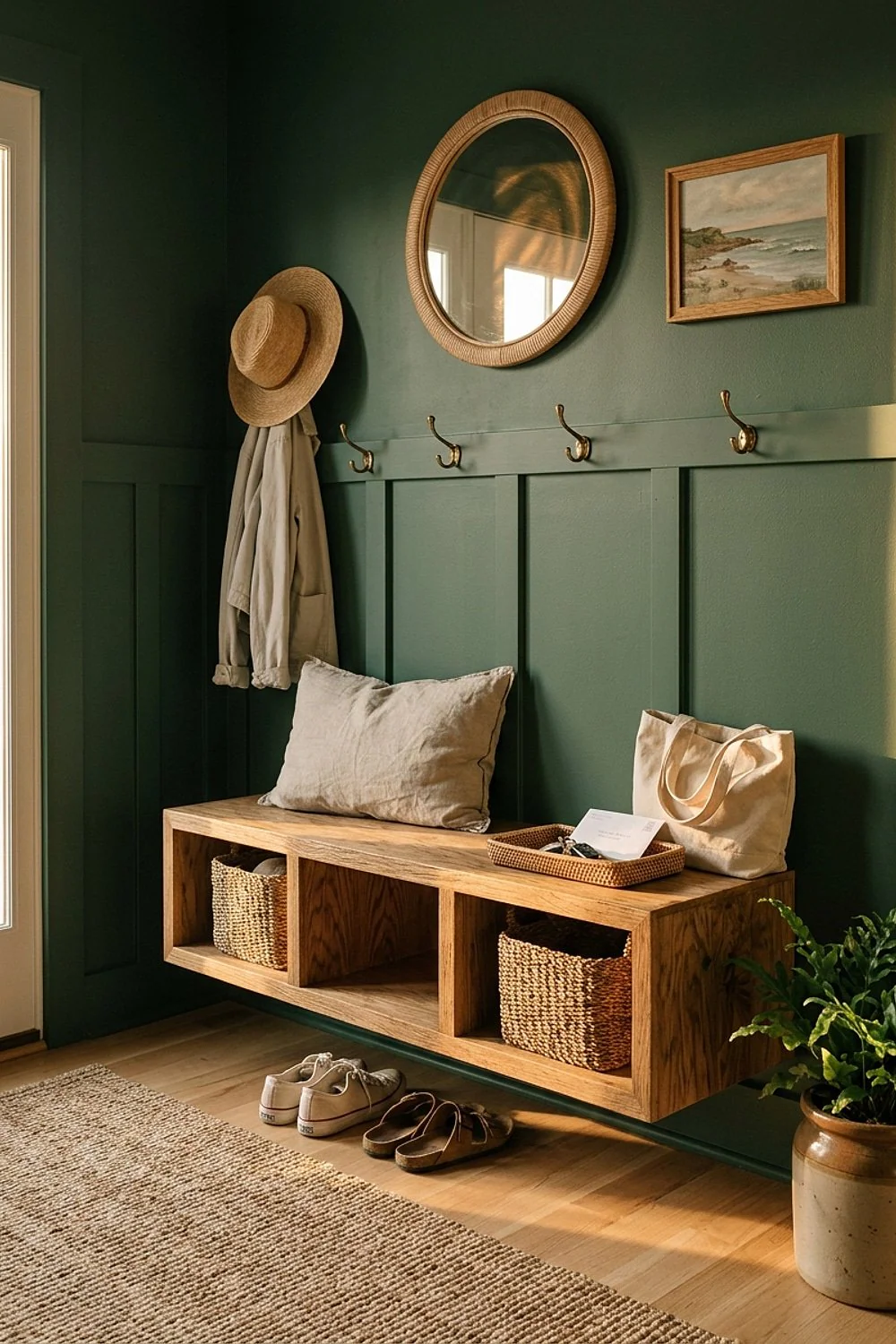
Floating shelves and benches arrived with mid-century modernist interiors, and they clear the floor so a small hall reads as larger. A 12-inch-deep oak plank mounted at 18 inches high takes a seated adult without crowding the walkway.
Anchor it into studs with a French cleat rated for at least 200 pounds, and expect to pay about $60 for the hardware and a good plank. Drywall anchors alone will fail on the first heavy sitter.
16. Hall tree with a seat and hooks
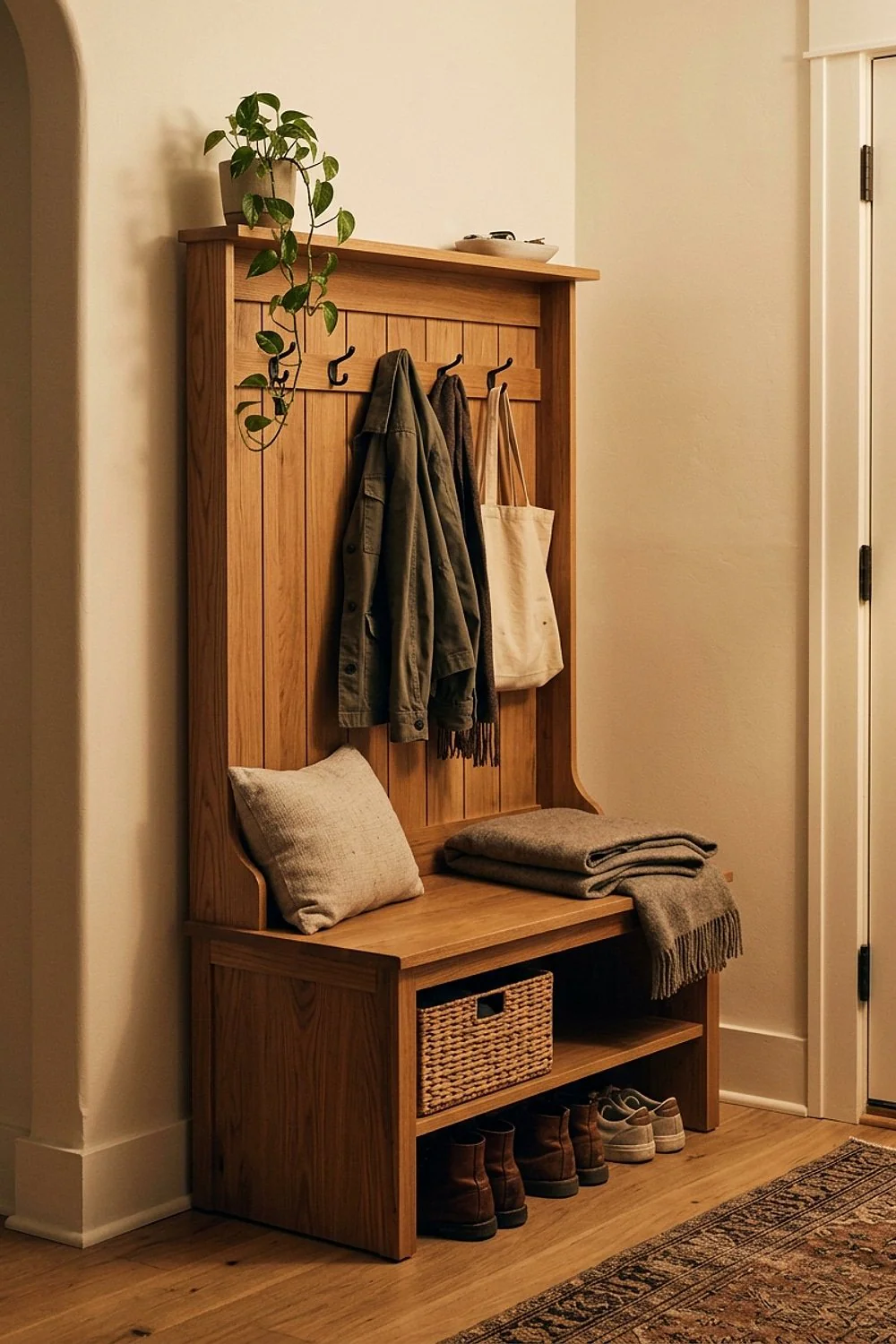
The Victorian hall stand combined hooks, a mirror, an umbrella well, and a lift-up seat in a single piece, and it’s still the most efficient use of a one-foot-wide wall. Coats hang above, and boots sit underneath.
Look for a base that’s at least 14 inches deep, or the whole thing tips when loaded with winter coats. Weighting the bottom shelf with shoes steadies it.
17. Danish teak bench with tapered legs
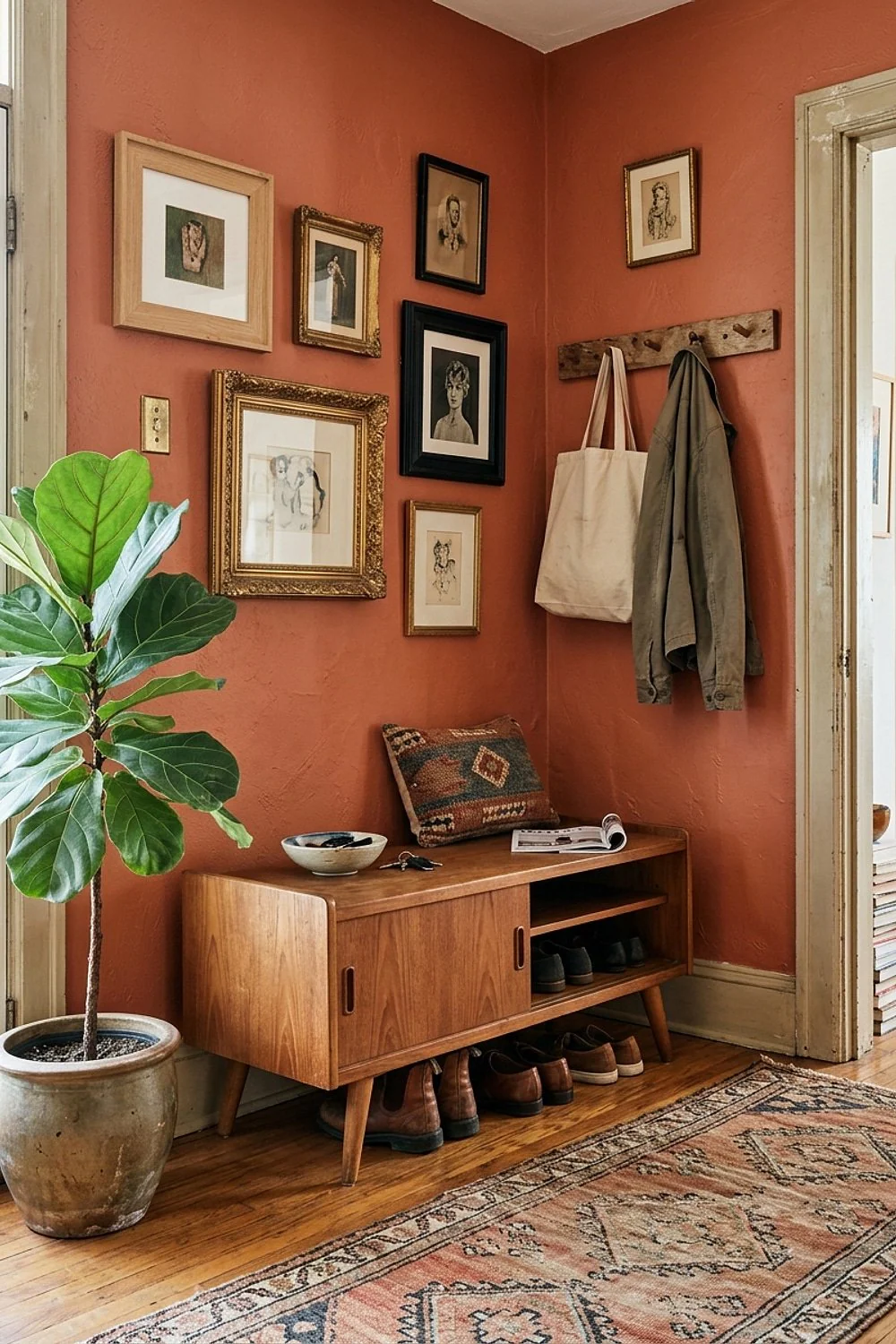
Danish designers of the 1950s and 1960s favored teak for its natural oils, which resist water far better than most hardwoods. A bench with a slim rail and splayed legs keeps a hall light, and it suits modern homes.
The classic mistake is buying thin teak veneer over particleboard, which swells at the first wet boot. Tap the underside; solid teak sounds dense and hollow-free.
18. Bench under a mirror and sconce
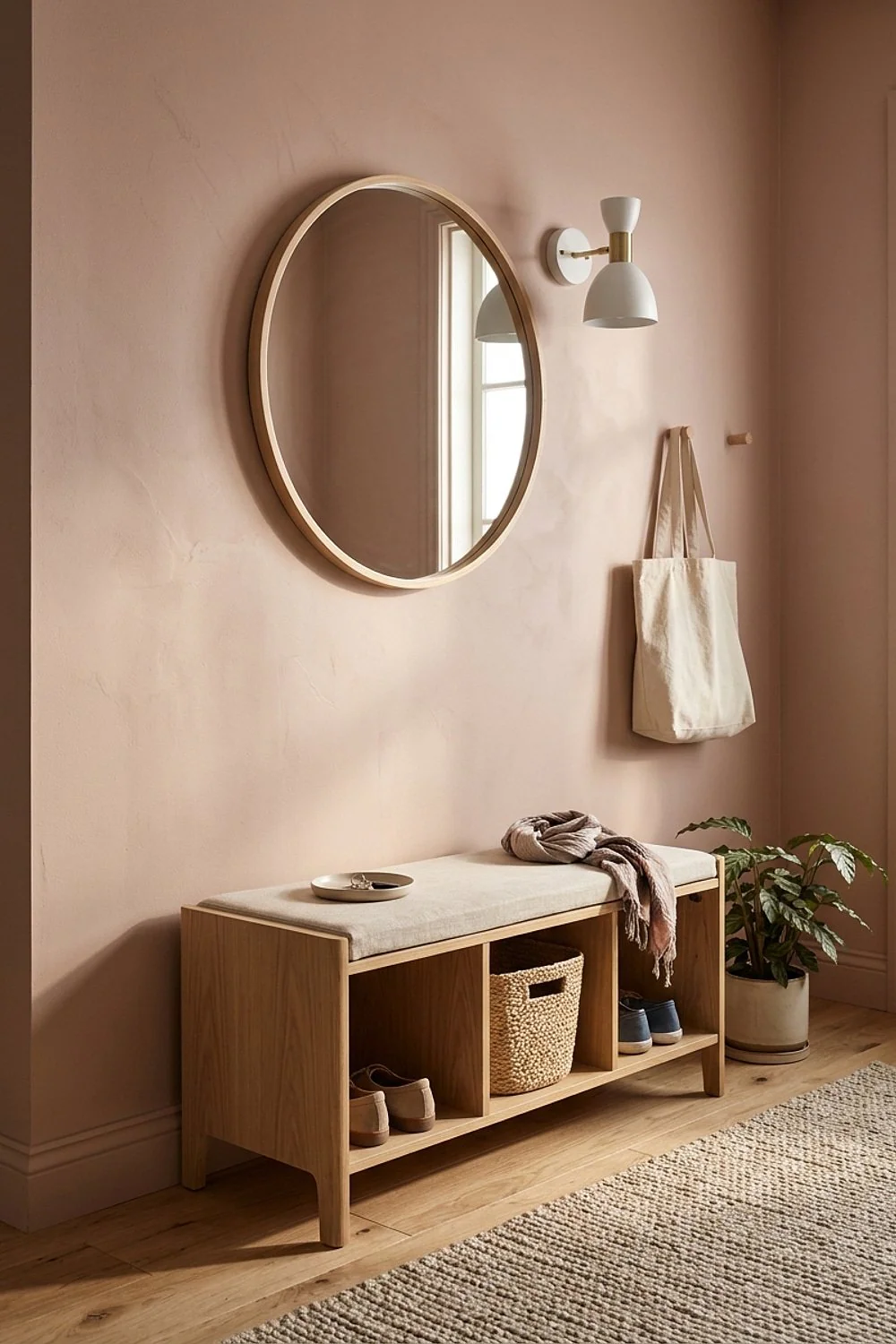
Hall seats with mirrors were standard in Victorian houses, so guests could check a hat before leaving. A 24 by 36 inch mirror above the bench bounces daylight down the hall and doubles the visual depth.
Hang a plug-in or hardwired brass sconce at about 66 inches to the center. A bulb at 2700 kelvin flatters wood and skin, while cooler bulbs make an oak bench look gray and flat.
19. Gustavian painted bench
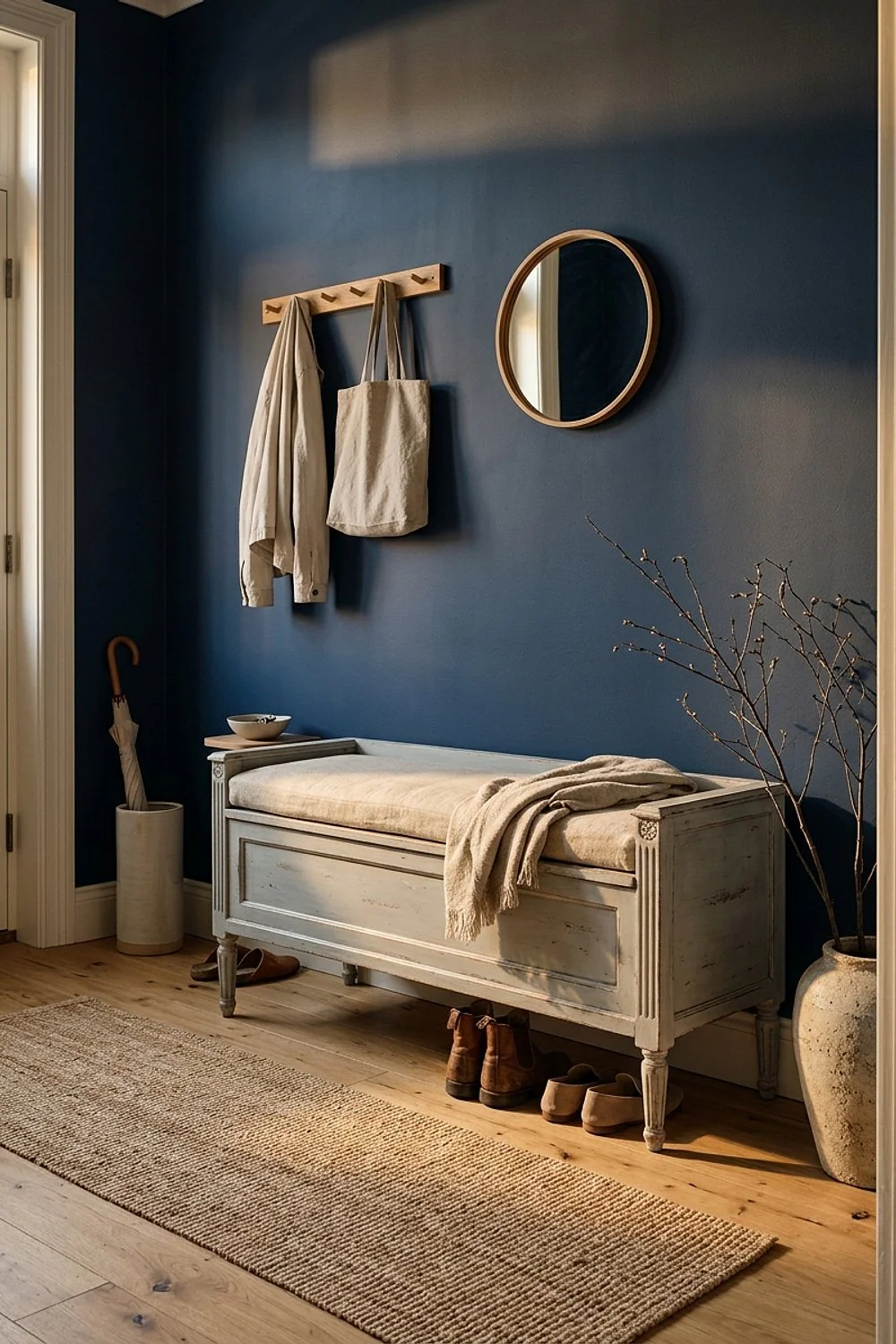
Swedish Gustavian furniture of the late 1700s borrowed French lines and softened them with chalky gray-blue and cream paint. Centered under a single large piece of art, a 40-inch bench of this type holds a hall in perfect symmetry.
It suits a formal entry with a centered door and not much else. A bench off-center on the wall looks like a mistake, because the style depends on being balanced.
20. Ebonized bench with brass hardware
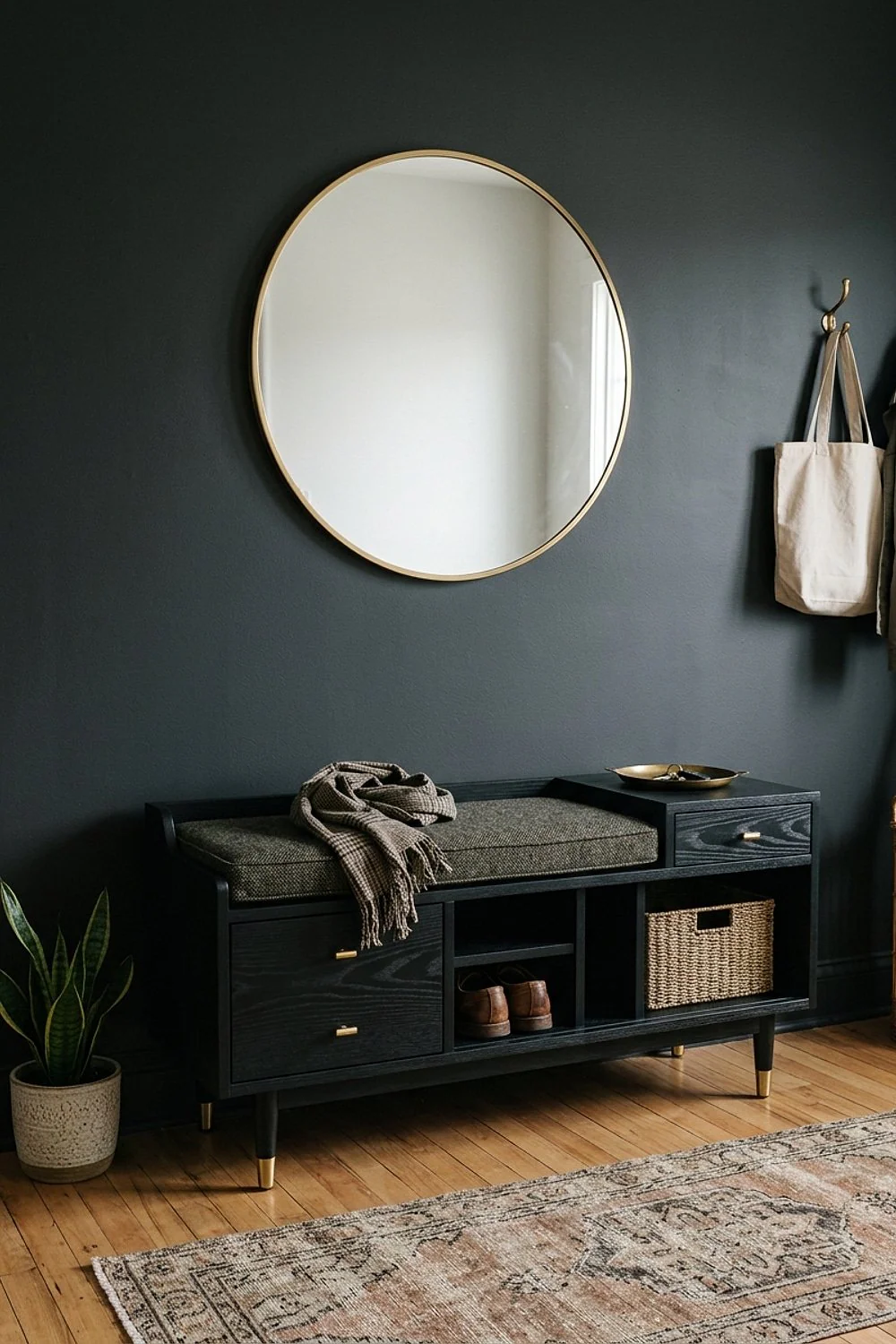
Ebonizing, staining wood black to imitate ebony, was a hallmark of the Aesthetic movement in the 1870s and 1880s. A black bench with brass pulls or hinges gives a pale hall a single dark, defined edge, and it hides scuffs well.
A genuinely ebonized finish costs around $200 to $400 for a small bench, since it’s usually hand-applied. Black paint is a respectable shortcut, but let it cure for two full weeks before it meets boots.
21. Windsor-style spindle bench
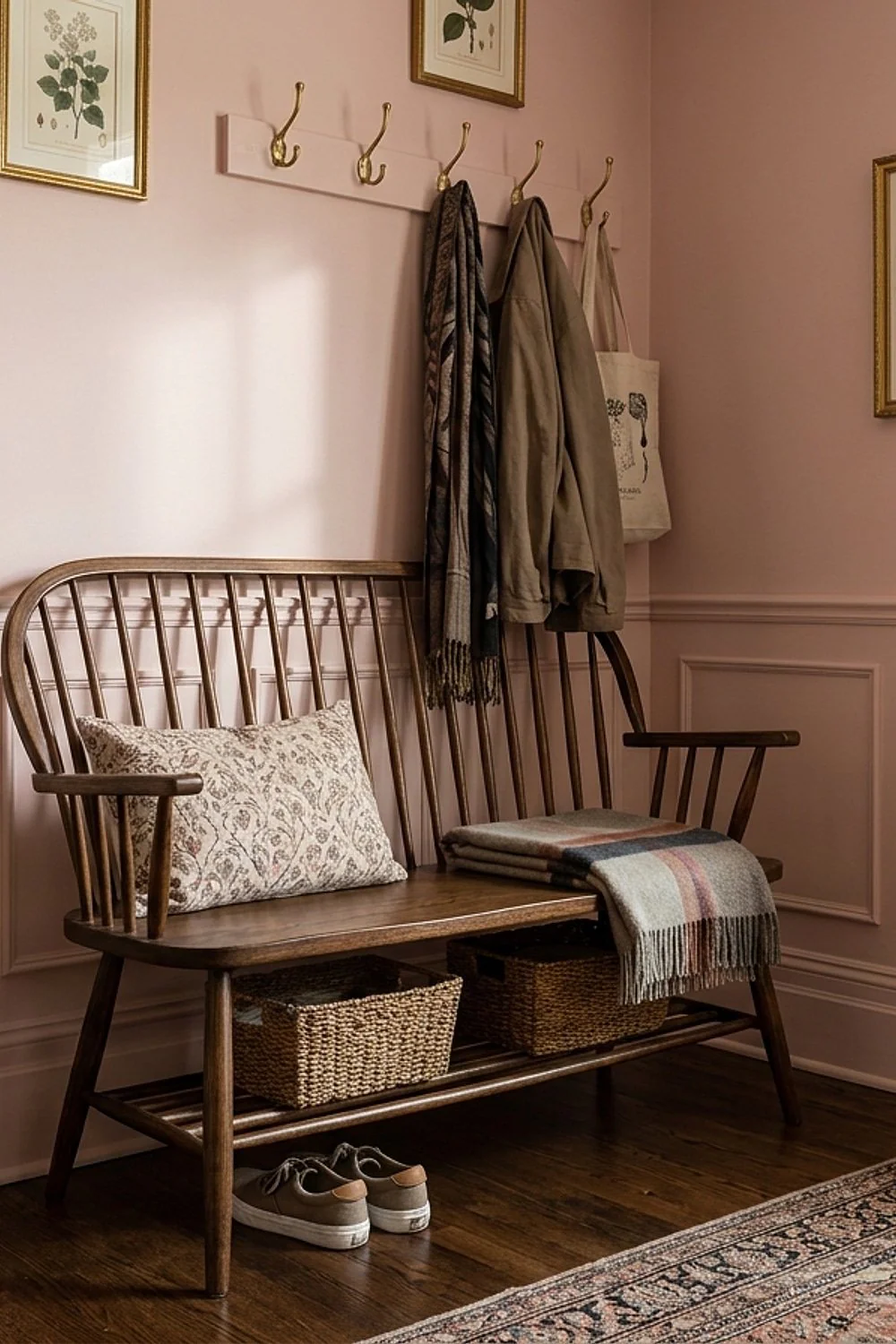
Windsor benches began as English country furniture in the early 1700s, with a saddle seat and turned spindles cut from ash, elm, and beech. The slim back gives support without blocking light, which matters in dark halls.
Look for a seat at least 1.25 inches thick, because thin seats crack along the grain. This style is the right call for a sitting-heavy entry where someone lingers to chat before leaving.
The pieces that earn their place
A small entryway storage bench ought to outlast three paint colors and two floor refinishes. That means judging it by joinery and wood species, not by whatever trim or finish trended last spring.
Solid wood with dovetailed or doweled joints repairs easily and resells well. Particleboard with a printed woodgrain does neither, and it swells at the first wet boot.
- Investment signs: solid hardwood, visible joinery, a finish that can be sanded and redone, hardware screwed rather than stapled.
- Fad signs: foil-wrapped boards, glued cam-lock frames, novelty shapes, and finishes that only work in one color story.
Walls don’t negotiate. A bench has to match the space it’s in, and no amount of good wood fixes a piece that’s 4 inches too deep.
Updating classics without losing them
A rainy Sunday in November is a good time to repaint or reupholster, since entry benches take the worst wear by then. Swapping a seat cushion or hardware changes the whole mood in about an hour, and the structure stays put.
Half-measures are tempting. A quick wipe of paint over a dirty, glossy surface looks fine for a week, then peels in strips by January, and the job has to be done twice.
Better to do it right the first time: degrease, scuff-sand with 180-grit paper, prime, and apply two thin coats. The whole thing takes one afternoon, and the finish lasts for years.
- Swap pulls and hinges for aged brass or blackened iron.
- Recover the cushion in a tight wool or a performance weave.
- Repaint in a muted color rather than a trending one.
Measurements that decide everything
Before any bench is chosen, tape its footprint on the floor and walk past it with a laundry basket. That test shows in ten seconds what a catalog photo never will.
A small entryway storage bench needs 30 inches of clear walkway in front of it, and 36 inches wherever a door swings. Anything less turns daily coming and going into a shuffle.
- Measure the wall width between door, corner, and any radiator.
- Subtract 3 inches from the width so the bench doesn’t touch either end.
- Check the door swing and trim depth against the bench’s depth.
- Set the seat height between 17 and 19 inches for adult knees.
Common mistakes
A small entryway storage bench takes more abuse than any other seat in the house, because it meets wet boots, bags, and dogs before anything else does. Even a good bench fails when a few predictable mistakes pile up.
Placing it directly against a heating vent warps veneer and dries out leather. Leaving felt pads off the legs scratches the floor and invites sliding.
Buying a bench in a trend color is the third offender. Wood tones and deep neutrals move with a house through decades, but a bright seasonal shade dates itself fast.
The bench that stays
The styles above share a few traits: honest materials, sound joinery, and proportions tuned to people rather than photographs. Pick one that matches the wall and the household, and a small entryway storage bench will outlast the rest of the room’s decor.
Save or pin this list so it’s handy when it’s time to buy. For a first step, measure the wall between the door and the nearest corner, then compare that number to the dimensions in items 5 and 15.
Frequently asked questions
How deep should a small entryway storage bench be?
Aim for 14 to 16 inches in most halls, and drop to 12 inches if the walkway is under 40 inches wide. Anything beyond 18 inches belongs only in a wide mudroom.
Can a small entryway storage bench work in a rental?
Yes, as long as it’s freestanding. A bench with felt pads needs no drilling, and a lift-lid or open-shelf model gives rental halls storage without touching a wall.
How much weight should an entry bench hold?
Look for a rating of at least 250 pounds, since two adults may sit at once and bags add load. Solid wood with doweled joints usually clears that easily, and flat-pack frames often don’t.
What finish handles wet boots best?
A satin polyurethane or hard-wax oil resists water and can be touched up in place. Avoid wax alone and unsealed paint, since both stain at the first puddle.